
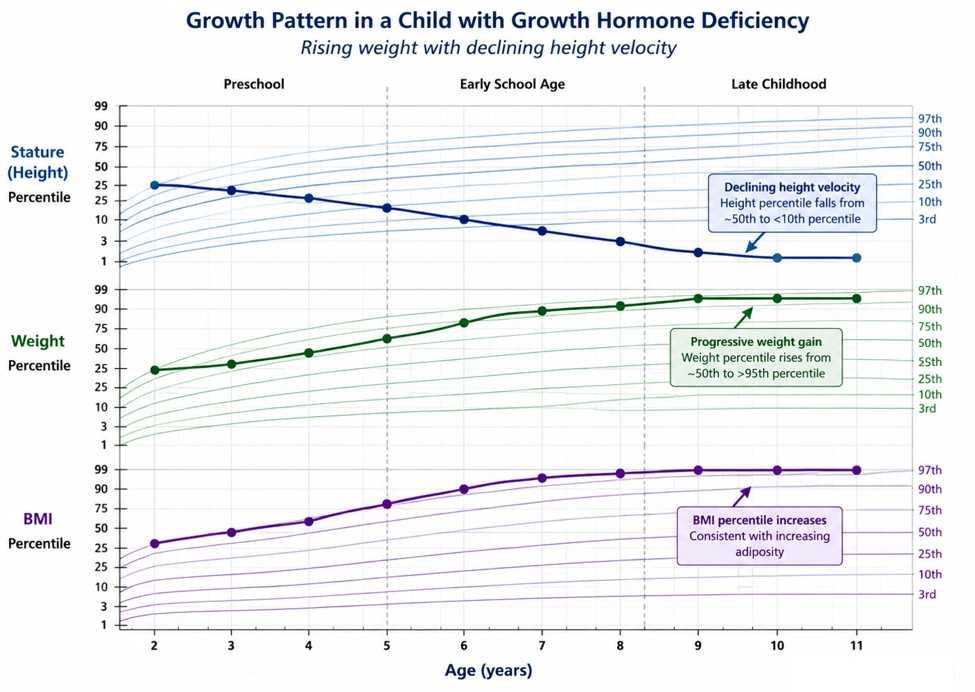
Growth hormone deficiency (GHD) is included in the ABOM test content blueprint, specifically requiring the knowledge to identify signs and symptoms of this condition. Diagnosing secondary causes of obesity is an important task in this exam and in clinical practice. A deep endocrinology-level understanding of this condition and its treatment is not needed; rather, the goal is to differentiate GHD from other similarly appearing obesity etiologies. In a prior blog (here), we discussed childhood growth charts, including the differential diagnosis of a child with an increased BMI percentile, but decreased linear growth, as shown below. This pattern typically represents endocrinopathies such as hypothyroidism or Cushing syndrome, but GHD should also be considered, which will be the topic of today’s blog.
Growth hormone is a peptide secreted by the anterior pituitary gland under regulation by the hypothalamus. In children, its primary role is to stimulate linear bone growth, but it also has important metabolic effects, including increasing protein synthesis, promoting lipolysis, and helping preserve lean body mass. Many of these effects are mediated through stimulation of insulin-like growth factor 1 (IGF-1) production in the liver and other tissues. Excessive growth hormone production leads to gigantism in children, whose growth plates remain open, and acromegaly in adults. In contrast, GHD results in impaired height velocity, short stature, increased adiposity, and reduced lean body mass.
Decreased height velocity or growth failure is often the first presenting sign of GHD, although more severe congenital forms will have secondary characteristics that may be more apparent as an infant, including frontal bossing, hypotonia, and hypoglycemia. GHD may be isolated and acquired, such as occurring with intracranial tumors or trauma, similarly to hypothalamic obesity. It can also present as part of a broader syndromic etiology, which is often the case with Prader-Willi syndrome (read more on PWS here). Children with decreased height velocity, severely short stature (less than 2.5 standard deviations below the mean), or features of other hypothalamic-pituitary dysfunction require evaluation.
Evaluation for GHD requires ruling out other causes of poor linear growth, including hypothyroidism, skeletal disorders, Turner syndrome in girls, undernutrition, and other systemic diseases. If these conditions are not identified, further biochemical testing is pursued. Because growth hormone is secreted in a pulsatile fashion, random growth hormone levels are generally not useful; instead, initial screening typically includes measurement of IGF-1, which reflects growth hormone activity. Bone age is also assessed, as delayed bone age is commonly seen in GHD, whereas a normal bone age makes significant GHD less likely. Definitive diagnosis generally requires growth hormone stimulation testing and is typically performed by pediatric endocrinologists.
Treatment of GHD is not specifically listed within the ABOM blueprint, but it is important to recognize that recombinant human growth hormone is the primary therapy. Interestingly, one of the more notable complications of treatment is slipped capital femoral epiphysis, which is thought to be related to the rapid growth acceleration induced by treatment rather than to a direct medication side effect. In addition, despite improvements in lean body mass and linear growth, growth hormone therapy can increase insulin resistance and may lead to impaired glucose tolerance.
You do not need to be an expert in GHD to master the material required for the test. Focus on recognizing the characteristic growth pattern in children, namely increasing weight relative to height accompanied by reduced linear growth velocity, and understand that bone age is typically delayed compared with chronological age. Advanced diagnostic details will not be required, and although treatment is not specifically listed within the blueprint, recombinant growth hormone is the intuitive therapy if presented as an answer choice. Understanding these key concepts should prepare you well for any GHD-related questions on exam day.
Sample Question
A 7-year-old boy presents for follow-up evaluation of excessive weight gain. Review of his growth chart demonstrates progressive weight gain with declining linear growth velocity over the past several years. His BMI percentile has steadily increased, while his height percentile has fallen from the 50th percentile to below the 10th percentile. Further evaluation confirms growth hormone deficiency. Which of the following conditions would be expected to demonstrate a similar pattern on the growth chart?
A. Isolated excess caloric intake
B. Melanocortin-4 receptor deficiency
C. Hypothyroidism
D. Diabetes
Next Week: Discontinued Anti-Obesity Medications
Upcoming: Endoscopic Therapy Guidelines and Procedures and a Motivational Interview Question Walk Through
For more practice questions, check out the following:
- Obesity Medicine Board Review Questions (2026): Qs 25 and 85.
- Obesity Medicine Practice Tests (2026): Qs 137 and 217.
(Copyright 2026) Obesity Medicine Board Review Questions, LLC: obesitymedicinereview.com
Featured image: Modified from VectorStock (image license purchased)
Copyediting by Kelly Smith
Now available: A full line of ABOM study resources with 775+ challenging questions in a mobile or book format. Access to both formats is available in a discounted Ultimate Package, which also includes a Pass Guarantee (if you fail the exam in 2026, you get the 2027 edition free), 50 bonus questions released in August, and the newest book, Obesity Medicine: Sample Questions and Study Blogs, which includes all the updated previous study blogs in a paperback format. Check it out here!
