
In recent years, a growing number of medical subspecialties have released specialty-specific guidance on the use of anti-obesity medications (AOMs) and weight management strategies. For instance, the American Gastroenterology Association has weighed in with its own guidelines on AOM use (recognized as an ABOM resource, viewable here), while the American College of Cardiology (ACC) recently recommended GLP-1 RA as first-line therapy for weight loss, prioritizing them even over intensive lifestyle modifications. Today’s blog will focus on the American Society of Nephrology’s (ASN) recommendations, offering a kidney-specific perspective on obesity treatment and the role of pharmacotherapy in patients with chronic kidney disease.
Within the past 20 years, those who meet the BMI criteria for obesity has increased from 30% to nearly 42%, with a disproportionate growth of class III obesity, doubling from 4.7% to 9.2% in this same time frame. This rise in adiposity not only increases risk factors for chronic kidney disease, including diabetic nephropathy, but also directly contributes to the increase of polycystic kidney disease, glomerular disease, and others. This latter effect is likely in part due to the detrimental effects of adiposopathy (sick fat). Not only does the increased BMI worsen renal disease, but severe obesity and truncal obesity also preclude patients from being listed on a renal transplant list. In contrast, weight loss slows or reverses this progression of renal disease, making it important. For these reasons, the ASN has released its guidelines for this population with obesity titled“ASN Health Guidance on the Management of Obesity in Persons Living with Kidney Disease,” found here.
The guidelines begin by addressing general lifestyle modifications, with a specific focus on individuals with renal disease. While the recommendations are largely similar to those for the general population, several important considerations and reassurances are highlighted. For instance, physical activity guidelines remain the same: 150 minutes per week of moderate-intensity activity for cardiovascular benefits, and a minimum of 200–300 minutes per week is required for initial weight loss and to support weight maintenance. Although long-term (>3 years) data on lifestyle interventions in advanced kidney disease are limited, partly due to challenges like fluid fluctuations, patients with CKD stages 1–4 have demonstrated the ability to achieve clinically meaningful weight loss. Even in those with renal dysfunction, lifestyle interventions rarely result in serious adverse effects; however, diets high in potassium and phosphate should be avoided.
In addition to lifestyle modifications, psychosocial factors are often amplified in individuals with renal disease. The mental health burden of obesity, commonly associated with major depressive disorder (32%) and anxiety (24%), is frequently compounded by the demands of renal disease, which requires significant time, resources, and frequent medical evaluations. Weight stigma and discrimination are linked to poorer health outcomes, while internalized stigma (self-directed negative beliefs) can further deteriorate mental health. To help alleviate these challenges, healthcare professionals and staff should be trained to use person-first, non-stigmatizing language and recognize that weight loss is generally associated with improvements in mental health. However, weight regain may negatively impact mental well-being, even beyond the initial baseline. A low threshold for referring patients to mental health professionals is strongly recommended.
Like the ACC, ASN acknowledges that only 1 in 4 individuals will maintain substantial weight loss through lifestyle modifications alone. Thus, pharmacologic and surgical interventions form a major part of the guidance. AOMs can help prevent CKD progression and facilitate earlier transplant eligibility. In contrast to the newer ACC guidelines that favor earlier pharmacotherapy, the ASN recommends a 3-6 month trial of lifestyle modification before initiating AOMs, emphasizing that lifestyle modifications offer synergistic health benefits alongside pharmacotherapy.
GLP-1 RA are highlighted as the most effective and safe AOM class in those with renal disease, as no dose adjustments are needed in those with renal impairment. However, gastrointestinal side effects should be monitored during titration, because if severe, it could lead to dehydration and a pre-renal acute kidney injury. Other general suggestions include recommending that patients should avoid high-fat meals and behaviors that exacerbate GERD (e.g., lying down after eating, rapid eating, and consuming large portions). For patients on insulin or sulfonylureas, hypoglycemia risk necessitates dose reductions and glucose monitoring. Home blood pressure monitoring is also advised to prevent hypotension associated with significant weight loss in those on antihypertensives.
Several studies cited in the guidelines demonstrated renal benefits from GLP-1 RAs:
- In the E-RESEARCH trial, semaglutide reduced albuminuria by 25% in patients with type 2 diabetes.
- In the SELECT study, a renal composite outcome improved by 22%, including a reduction in albuminuria and a slower decline in eGFR.
- Liraglutide 1.8 mg daily led to a 22% reduction in renal composite outcomes, including microalbuminuria.
- Similar benefits were observed in studies like STEP 1–3, FLOW, PIONEER 5, and AWARD 7.
Although the article primarily emphasizes the renal benefits of GLP-1 receptor agonists and their role in slowing kidney disease progression, it also briefly addresses other FDA-approved anti-obesity medications, summarized below:
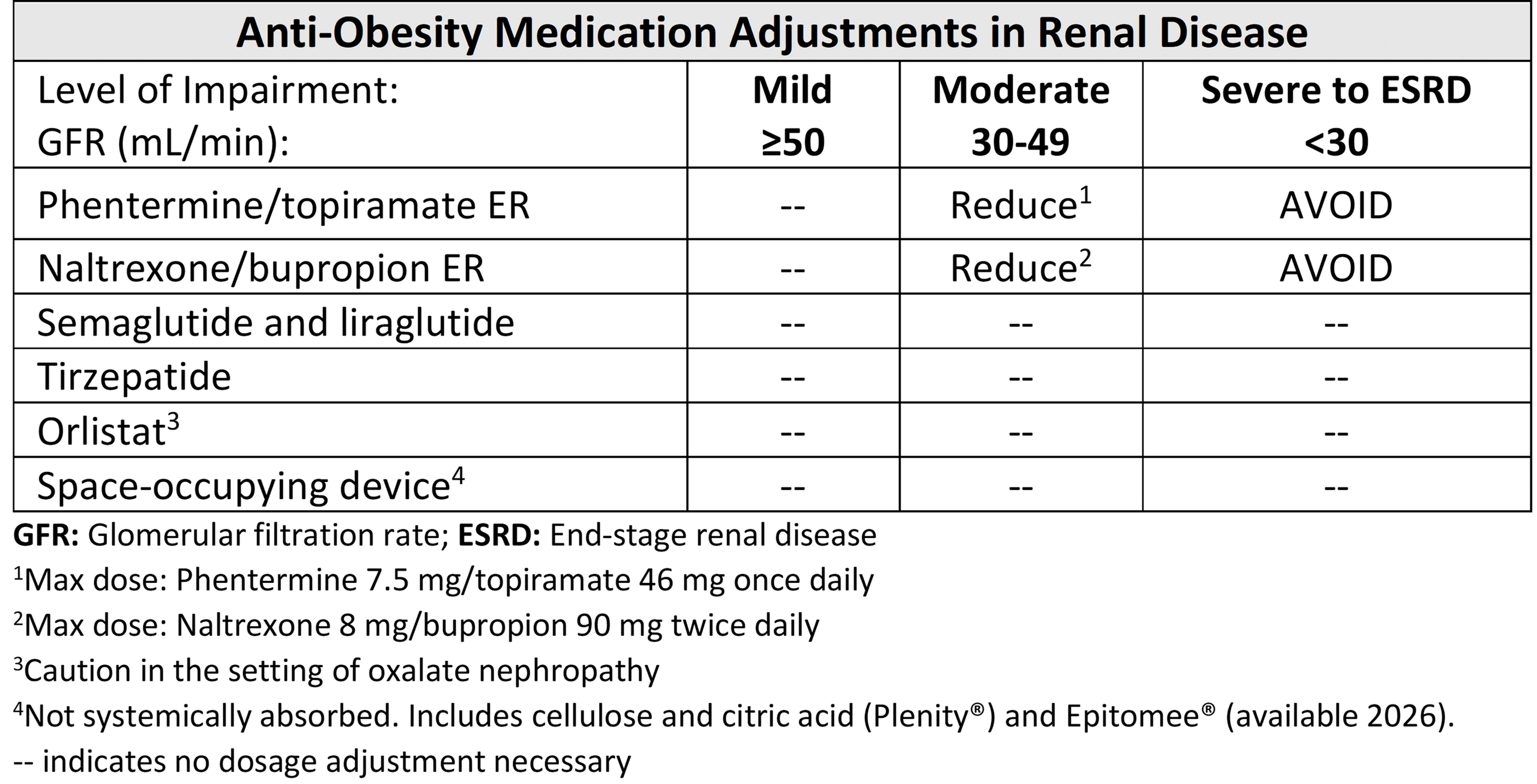
- Naltrexone/bupropion ER: Due to limited renal-specific studies, its effects on kidney outcomes remain unclear. However, it is absolutely contraindicated in cases of uncontrolled hypertension or kidney failure.
- Orlistat: This agent reduces fat absorption, resulting in approximately 3- 5% weight loss. However, its long-term impact on renal and cardiovascular outcomes has not been well studied. From a renal perspective, orlistat may increase the risk of oxalate nephropathy, and gastrointestinal side effects often limit its use.
- Phentermine/topiramate ER: Dose adjustments are necessary in patients with renal impairment, and use is not recommended in advanced kidney disease. Like the others, its impact on renal outcomes and mortality has not been directly evaluated.
The chart below summarizes the indicated renal adjustments of FDA-approved anti-obesity medications.
In addition to FDA-approved anti-obesity medications, several off-label agents are discussed for their relevance in patients with kidney disease. For example, metformin is associated with modest short-term weight loss and long-term weight maintenance. While the exact mechanisms behind its weight effects are not fully understood, they are believed to involve improved insulin sensitivity, reduced hepatic gluconeogenesis, and potential modulation of the gut microbiota. However, its use in patients with chronic kidney disease is limited by eGFR thresholds, as dose adjustments are required in moderate renal impairment, and use is contraindicated in advanced or end-stage disease due to the risk of lactic acidosis.
SGLT-2 inhibitors are also addressed for their cardiovascular and renal benefits, as well as their modest weight loss effects. These agents promote the urinary excretion of glucose of approximately 75 grams daily, equivalent to about 300 kilocalories per day (recall that 1 gram of carbohydrate = 4 kcal). In patients with type 2 diabetes, the average 2.7 kg weight loss typically occurs within the first month of treatment. In a patient who is no longer making urine (end-stage renal disease), the weight benefits will be lacking, although other renin-independent (cardiac) benefits persist.
Aside from GLP-1 receptor agonists, other anti-obesity medications offer less impressive weight loss outcomes in patients with renal disease, have limited data on renal effects, and often require dosing adjustments based on glomerular filtration rate. As a result, the final section of the guidelines focuses on metabolic and bariatric surgery (MBS), which is both effective and generally considered safe for patients with kidney disease. While ESRD is not a contraindication, complications and mortality risks are slightly higher, though still relatively low, and often outweighed by the potential benefits. MBS in this population presents unique challenges that require a multidisciplinary team, including a nephrologist, to manage fluid balance under fluid restrictions. In addition, dietitians experienced in renal-specific nutritional counseling are strongly recommended to support optimal outcomes.
Research on outcomes after MBS in patients with renal disease is growing, though this population remains underrepresented in most studies. Postoperative improvements in GFR are often estimated using serum creatinine, which can be confounded by reduced muscle mass following significant weight loss. Nevertheless, weight reduction leads to decreased adipokine production, which improves podocyte function and reduces albuminuria. Additionally, reductions in angiotensin-related adipokines help lower blood pressure by attenuating the activation of the renin-angiotensin-aldosterone system. In a 5-year randomized controlled trial (Surgical Treatment and Medications That Eradicate Diabetes Efficiently [STAMPEDE] RCT), sleeve gastrectomy was associated with significant improvements in both GFR and proteinuria compared to medical therapy alone, although the trial predated widespread GLP-1 RA use. Other retrospective studies have shown that MBS is associated with a 60% reduced risk of kidney disease progression and a 44% lower risk of renal failure or death at 8 years, compared to GLP-1 RA treatment alone in patients with non-dialysis-dependent chronic kidney disease.
Beyond disease prevention, MBS offers an opportunity for patients with ESRD to meet BMI eligibility criteria for kidney transplant listing. In limited studies, nearly half of patients with ESRD and class III obesity became transplant-eligible within five years after undergoing MBS. Additionally, MBS is often more favorably covered by insurance plans compared to pharmacologic obesity treatments. Sleeve gastrectomy is generally preferred over malabsorptive procedures due to its lower risk of oxalate nephropathy, fewer concerns regarding nutrient and medication malabsorption (especially for immunosuppressant medications), and a reduced risk of anastomotic ulcerations.
The ASN guidelines represent a significant step in defining obesity care for patients with kidney disease, reinforcing the importance of a multidisciplinary approach that integrates lifestyle, pharmacological, and surgical therapies. Be familiar with them for both clinical practice and the ABOM exam.
Sample Question
A 49-year-old man with end-stage renal disease on hemodialysis presents to an obesity medicine specialist to discuss weight loss options. He has a BMI of 44 kg/m² and wishes to be evaluated for renal transplantation, but has been told his weight makes him ineligible. Which of the following is the most appropriate recommendation?
A. Avoid surgery due to high mortality risk in ESRD
B. Start naltrexone/bupropion and reassess monthly
C. Refer for sleeve gastrectomy evaluation
D. Focus on high-intensity lifestyle therapy
E. Initiate a SGLT-2 inhibitor for its weight loss and renal benefit
Next Week: Functional foods
Following Week: Preoperative evaluation
Upcoming: Pediatrics: Bullying, Stigma, and Food Insecurity
For more practice questions, check out the following:
- Obesity Medicine Board Review Questions (2026): Q 174.
- Obesity Medicine Practice Tests (2026): Qs 1 and 194.
(Copyright 2026) Obesity Medicine Board Review Questions, LLC: obesitymedicinereview.com
Featured image: Modified from VectorStock (image license purchased)
Copyediting by Kelly Smith
Now available: A full line of ABOM study resources with 775+ challenging questions in a mobile or book format. Access to both formats is available in a discounted Ultimate Package, which also includes a Pass Guarantee (if you fail the exam in 2026, you get the 2027 edition free), 50 bonus questions released in August, and the newest book, Obesity Medicine: Sample Questions and Study Blogs, which includes all the updated previous study blogs in a paperback format. Check it out here!
