
Rare genetic conditions associated with obesity are highlighted on the ABOM exam test content outline, though the level of detail and difficulty varies. To be well-prepared, it’s important to differentiate between syndromes, understand any specific treatments, and memorize their inheritance patterns. Previous blogs have discussed several genetic causes of obesity, but Wilson-Turner syndrome has not yet been covered, which will be the focus of this brief post.
Wilson-Turner syndrome is an extremely rare X-linked genetic syndrome associated with obesity, caused by mutations in the HDAC8 gene located on the Xq13 locus. Both X-linked recessive and dominant patterns have been described, but like other X-linked conditions, it more frequently affects males. Females are more often carriers, and if symptomatic, they tend to experience milder features due to lower penetrance.
Because of its rarity, much of what is known about Wilson-Turner syndrome comes from a small number of families. In fact, two well-characterized families provide most of the clinical data available. In one family, 14 males across three generations were affected; in the other, 7 males and 7 females were found to carry the mutation.
Clinical features typically become evident in early childhood and can phenotypically overlap with Börjeson-Forssman-Lehmann syndrome, another X-linked disorder. Because of this overlap, the ABOM exam is unlikely to require distinction between the two based solely on clinical presentation. In males, common findings include:
- Severe intellectual disability
- Predominantly truncal obesity
- Gynecomastia
- Hypogonadism or cryptorchidism (undescended testes, often located in the inguinal canal or absent)
- Dysmorphic facial features, including deep-set eyes, broad nasal tip, thin upper vermillion, retrognathia (receding jaw), small head (microcephaly), short ears, and prominent supraorbital ridges
As noted, females who carry the mutation tend to have milder symptoms, such as learning difficulties and subtle facial features, though many carriers are phenotypically normal.
When preparing for the ABOM exam, it is essential to memorize inheritance patterns for genetic causes of obesity. Questions may include a clinical scenario and ask about the mode of inheritance, making this a high-yield topic. A summary table of commonly tested genetic conditions and their inheritance patterns is provided below.
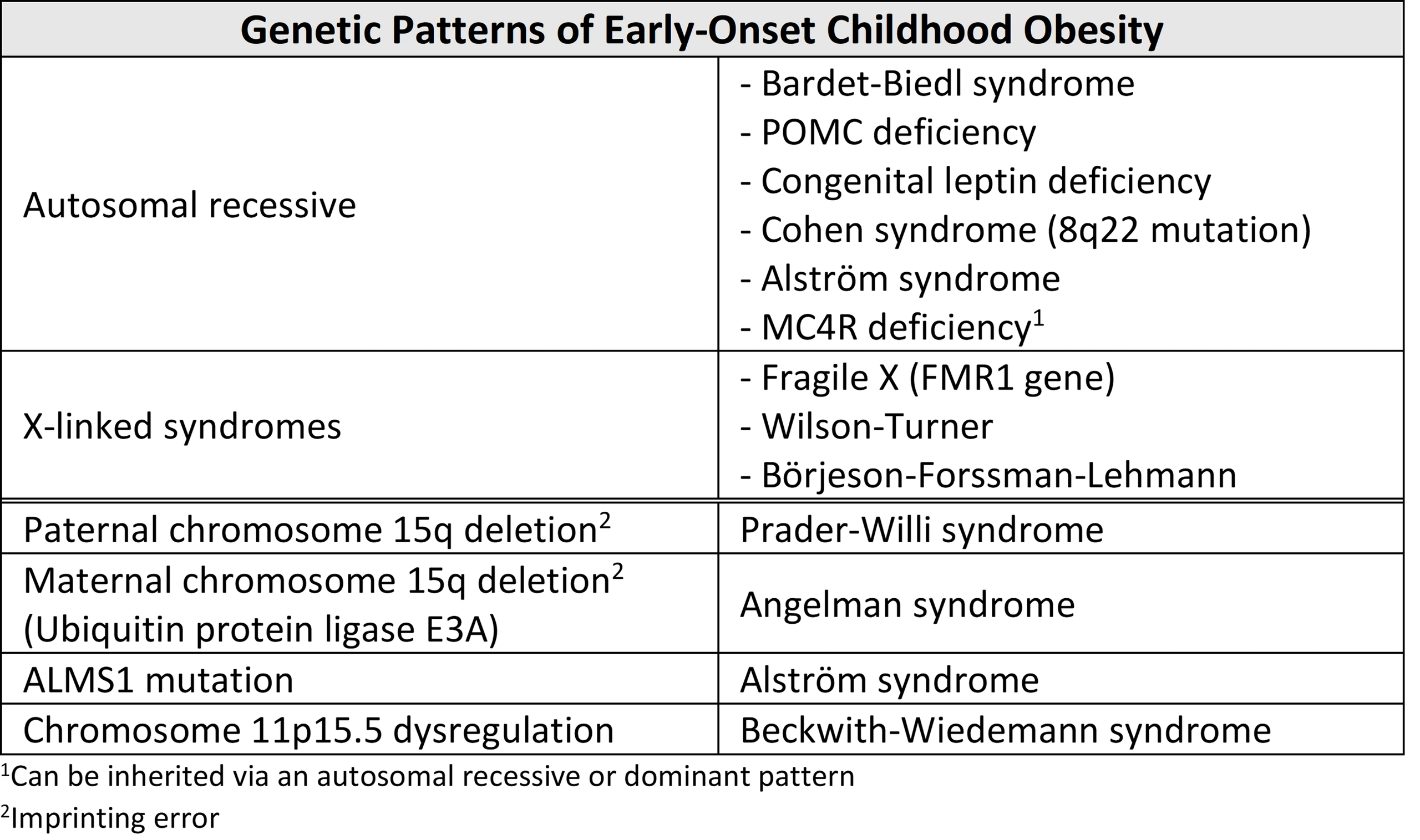
Additionally, categorizing genetic obesity syndromes based on the presence or absence of intellectual disability can be a helpful strategy for board preparation. In general, most monogenic causes of obesity, defined as involving a single gene defect in the hunger or satiety pathways, such as MC4R deficiency or POMC deficiency, are not associated with intellectual impairment.
In contrast, many syndromic forms of obesity, in which obesity is one component of a broader constellation of clinical features, are often associated with variable degrees of intellectual disability, ranging from mild to severe. Examples of these include Prader-Willi syndrome, Albright’s Hereditary Osteodystrophy, Fragile X syndrome, Bardet-Biedl syndrome, and Cohen syndrome. Notable exceptions to this pattern include Alström syndrome and Beckwith-Wiedemann syndrome, both of which are typically associated with normal intellect.
Wilson-Turner syndrome is a rare condition, but you should expect to see it at least once on the ABOM exam, possibly more frequently as a distractor option. The likelihood of encountering it on the exam is exponentially higher than in clinical practice. Be sure to know its clinical features, including the presence of intellectual disability, and its inheritance pattern. You should also be able to classify other genetic causes of obesity by inheritance pattern and recognize which are associated with intellectual impairment.
Sample Question
A clinical geneticist is creating a series of online educational videos for her patients to help them understand the inheritance patterns of various genetic causes of obesity. She plans to organize the videos by inheritance pattern (e.g., autosomal dominant, autosomal recessive, X-linked) and tag each syndrome accordingly. She is currently developing content on X-linked inheritance patterns and wants to ensure she categorizes the appropriate conditions accurately. Which of the following pairs of obesity-associated conditions should be tagged under X-linked inheritance?
A. Alström syndrome and Wilson-Turner syndrome
B. Bardet-Biedl syndrome and Angelman syndrome
C. Fragile X syndrome and Börjeson-Forssman-Lehmann syndrome
D. Prader-Willi syndrome and Beckwith-Wiedemann syndrome
E. Cohen syndrome and Alström syndrome
Take it an extra step: What categories would the other conditions fall into?
Next Week: Monthly Knowledge Check. This is a review checklist of must-know items for ABOM exams based on the previous four blog topics (Cushing’s Syndrome, Wilson-Turner Syndrome, Transoral Reduction Outlet Procedure, Obesity and Cancer). In addition, this will include a brief explanation of the correct answers to previous sample questions.
Upcoming: Very-low-calorie diet, Adverse Childhood Events and Antibiotics, Underwater Weighing, and Brown/Beige adiposity
For more practice questions, check out the following:
- Obesity Medicine Board Review Questions (2026).
- Obesity Medicine Practice Tests (2026): Q 264.
(Copyright 2026) Obesity Medicine Board Review Questions, LLC: obesitymedicinereview.com
Featured image: Modified from VectorStock (image license purchased)
Copyediting by Kelly Smith
Now available: A full line of ABOM study resources with 775+ challenging questions in a mobile or book format. Access to both formats is available in a discounted Ultimate Package, which also includes a Pass Guarantee (if you fail the exam in 2026, you get the 2027 edition free), 50 bonus questions released in August, and the newest book, Obesity Medicine: Sample Questions and Study Blogs, which includes all the updated previous study blogs in a paperback format. Check it out here!
