

Each year, certain high-yield topics tend to give candidates more trouble than others, and this year Cushing syndrome was an area that candidates felt they could use a refresher. Cushing syndrome refers to the clinical condition caused by chronic exposure to excess glucocorticoids, whether exogenous (iatrogenic) or endogenous in origin. In this blog, we’ll review the essential features of this secondary cause of obesity, including clinical findings, underlying etiologies, and the diagnostic workup, tailored to what you need to know to succeed on the ABOM exam regardless of your medical specialty. This is not meant to be an endocrinology-level deep dive, but rather a practical refresher highlighting exam-relevant points.
Cushing syndrome is frequently underdiagnosed, especially in its iatrogenic form, even though over 10 million Americans receive glucocorticoid therapy annually. This suggests that iatrogenic Cushing syndrome is substantially more common than the literature reflects. Endogenous Cushing syndrome is less common but important to recognize. It is classified into three major etiologies, based on the etiology of excess cortisol:
- Pituitary ACTH-dependent (referred to as Cushing disease): This is the most common cause, accounting for approximately 65–70% of endogenous cases. It is caused by a functional pituitary adenoma that secretes adrenocorticotropic hormone (ACTH), stimulating bilateral adrenal cortisol production. The estimated incidence is about 7 cases per million person-years.
- Ectopic ACTH production: Accounting for 10–15% of cases, this form is due to non-pituitary tumors (paraneoplastic syndromes) secreting ACTH. Although the physiologic pathway is similar to Cushing disease, the source of ACTH is external to the pituitary, most commonly from pulmonary malignancies (especially small cell lung carcinoma) or neuroendocrine tumors.
- Adrenal tumors: Comprising the remaining 15–20% of cases, this category includes adrenal adenomas and adrenocortical carcinomas, producing cortisol independently of ACTH. These are roughly evenly split between benign and malignant tumors.
Cushing disease is significantly more common in women, with a 3- to 8-fold higher risk, and typically presents between the ages of 25 and 45. Similarly, adrenal tumors demonstrate a female predominance with a 4:1 ratio, most commonly occurring around age 50. In contrast, ectopic ACTH production has historically affected men more frequently (3:1), primarily due to the higher prevalence of ACTH-producing lung cancers in male smokers. However, this sex disparity is gradually narrowing as smoking rates among women have increased.
In treating individuals with obesity, we frequently encounter patients with metabolic syndrome, characterized by a constellation of obesity, hypertension, and glucose intolerance. However, routine screening for cortisol excess in all patients with this triad would be low yield, given the relative rarity of Cushing syndrome. Therefore, it is essential to rely on additional clinical clues to guide testing.
Common signs and symptoms associated with cortisol excess include central (truncal) obesity with disproportionately thin extremities, wide (>1 cm) purple striae, proximal muscle weakness, facial plethora, easy bruising, an increased supraclavicular fat pad, and a dorsocervical fat pad (“buffalo hump”) over the posterior neck and upper back. Other associated findings may include skin atrophy, frequent fungal infections, progressive weight gain, glucose intolerance, early-onset osteopenia or osteoporosis, and hypertension. The simultaneous presence of multiple features increases the specificity for Cushing syndrome.
In contrast, patients with adrenocortical carcinoma may present with weight loss rather than gain, and women are more likely to exhibit signs of androgen excess, such as menstrual irregularities, hirsutism, and virilization, all features more suggestive of a malignant adrenal cause of cortisol excess.
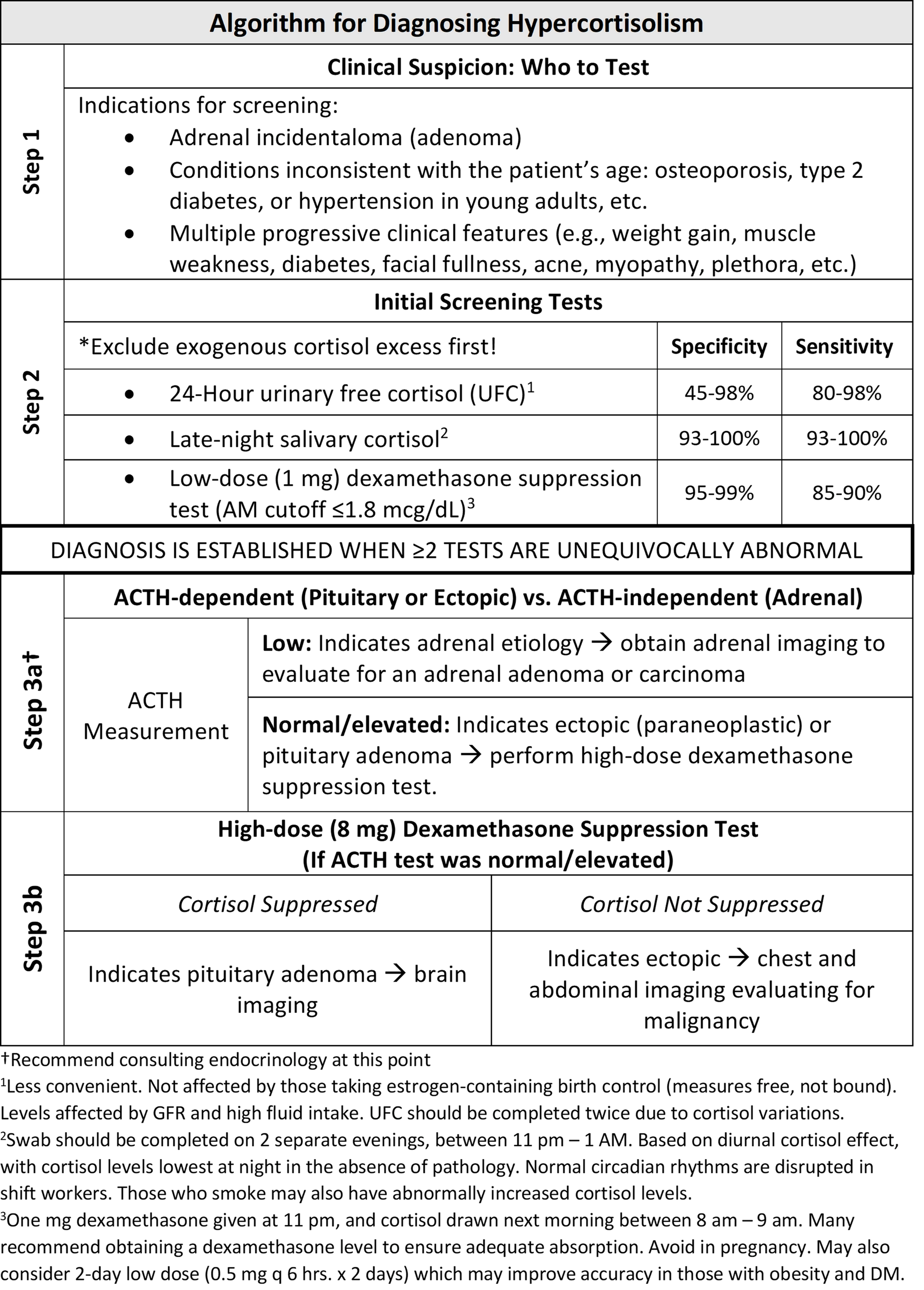
Additionally, any patient with an adrenal adenoma, whether discovered incidentally or through targeted imaging, should be evaluated for subclinical Cushing syndrome, given the potential for autonomous cortisol secretion even in the absence of overt clinical features. After exogenous steroid use is ruled out, initial screening for hypercortisolism typically involves one or more of the following three methods:
- Late-night salivary cortisol (buccal swab): Cortisol levels normally reach their lowest point (nadir) late at night. In individuals with Cushing syndrome, this diurnal rhythm is disrupted, resulting in elevated late-night salivary cortisol levels. This test is convenient, as it is performed at home using a buccal swab, and the sample remains stable for several days. Multiple collections over 2–3 nights can improve accuracy. However, this method may be unreliable in individuals with shift work or irregular sleep schedules, which can disrupt normal cortisol rhythms.
- 24-hour urinary free cortisol: This test measures unbound cortisol excreted in the urine over a full 24 hours and is especially useful when cortisol is secreted episodically, as can occur with tumors. It is best suited for patients with a moderate to high pre-test probability of Cushing syndrome. It is less sensitive in cases of mild or subclinical disease, and results may be affected by improper collection. To reduce false positives from physiologic hypercortisolism (e.g., obesity, depression, polycystic ovarian syndrome), a positive test should show levels ≥3 times the upper limit of normal. This test, along with salivary cortisol, may also be preferred in pregnant patients.
- Overnight 1 mg dexamethasone suppression test: For this test, 1 mg of dexamethasone is taken orally at 11 PM, and serum cortisol is measured at 8 AM the following morning. In individuals without Cushing syndrome, dexamethasone suppresses cortisol production. A morning cortisol level >1.8 µg/dL (50 nmol/L) suggests inadequate suppression and supports a diagnosis of hypercortisolism. This test should be avoided in patients taking oral estrogens (e.g., oral contraceptives) or during pregnancy, as elevated estrogen increases cortisol-binding globulin and can lead to falsely elevated cortisol levels.
If two or more initial screening tests are unequivocally abnormal, the diagnosis of hypercortisolism (Cushing syndrome) is confirmed. At this stage, the next step is to determine the source of cortisol overproduction. It’s important to note that if screening tests are positive, inconclusive, or discordant, a referral to endocrinology is recommended for further evaluation. For the ABOM exam, this likely is all the knowledge that is required; however, distractor options may include more advanced confirmatory tests, such as those discussed below.
Once hypercortisolism is confirmed, the plasma ACTH level is measured to determine whether the condition is ACTH-dependent or ACTH-independent:
- If ACTH is elevated or inappropriately normal, the source is ACTH-dependent, meaning cortisol production is being driven by pituitary or ectopic (paraneoplastic) ACTH secretion. This is similar to central hyperthyroidism, where both TSH and T4 levels are elevated.
- If ACTH is suppressed, the condition is ACTH-independent, indicating a primary adrenal source, such as an adrenal adenoma or carcinoma. In this case, the adrenal gland is producing cortisol autonomously, and ACTH is appropriately suppressed via negative feedback.
If ACTH is elevated or normal in the setting of confirmed hypercortisolism, a high-dose dexamethasone suppression test (8 mg overnight) may be considered to help differentiate between a pituitary source (Cushing disease) and an ectopic source. The rationale is that pituitary adenomas may retain partial feedback sensitivity and thus suppress cortisol production with high-dose dexamethasone, whereas ectopic ACTH-secreting tumors (e.g., from the lungs or pancreas) are resistant to suppression. Although this test is beyond what is typically required for the ABOM exam, you may see it as a distractor option. It is critical to recognize that high-dose dexamethasone testing is not used for initial screening.
A common board exam pitfall involves selecting imaging prematurely. Remember that imaging is one of the final steps, used only after biochemical confirmation of disease. Early imaging carries the risk of identifying incidental, non-functional lesions (e.g., adrenal incidentalomas or pituitary microadenomas), which may lead to unnecessary and misleading workups.
In summary, for board preparation, it is essential to focus on who to screen and how to screen, as these are high-yield concepts that fall squarely within the scope of an obesity medicine specialist. While most patients screened will not have Cushing syndrome, it is important not to overlook secondary causes of obesity, particularly in those with atypical presentations. In pediatric patients, special attention should be given to growth charts. If there is a disproportionate increase in weight accompanied by stagnant or declining linear growth, endocrine disorders such as Cushing syndrome or hypothyroidism should be considered in the differential diagnosis.
Sample Question
A 54-year-old woman presents to the clinic for follow-up after a recent emergency department visit for abdominal pain. A CT scan obtained to evaluate for diverticulitis incidentally revealed a 2.8-cm left adrenal mass consistent with an adenoma based on Hounsfield units. She reports no symptoms of palpitations, headaches, or diaphoresis. Medical history includes hypertension and hyperlipidemia. On physical exam, her blood pressure is 148/92 mm Hg, and BMI is 33 kg/m². She has central adiposity but no facial plethora, striae, or proximal muscle weakness. The physician plans to refer for endocrinology for concerns of an adrenal adenoma secreting excess cortisol. Which of the following is the most appropriate initial screening test in this patient?
A. Serum cortisol at 8 AM
B. Plasma-free metanephrines
C. ACTH stimulation test
D. Low-dose dexamethasone suppression test
E. Spot cortisol urine testing
F. No further testing is warranted
Next Week: Obesity Associated with Cancer
Following Week: Transoral Reduction Outlet Procedure
Upcoming: Wilson-Turner Syndrome
For more practice questions, check out the following:
- Obesity Medicine Board Review Questions (2026): Qs 86 and 128.
- Obesity Medicine Practice Tests (2026): Qs 30, 217, and 402.
(Copyright 2026) Obesity Medicine Board Review Questions, LLC: obesitymedicinereview.com
Featured image: Modified from VectorStock (image license purchased)
Copyediting by Kelly Smith
Now available: A full line of ABOM study resources with 775+ challenging questions in a mobile or book format. Access to both formats is available in a discounted Ultimate Package, which also includes a Pass Guarantee (if you fail the exam in 2026, you get the 2027 edition free), 50 bonus questions released in August, and the newest book, Obesity Medicine: Sample Questions and Study Blogs, which includes all the updated previous study blogs in a paperback format. Check it out here!
