
The updated pediatric guidelines that were released last year provide a significant shift in the approach of obesity management. The previous standard of care, The 2007 Expert Committee Recommendations on the Treatment of Childhood Obesity, offered a staged approach where children had escalating treatment intensity and availability to advanced therapies based on treatment timeframes. Although this staged approach predominated for 15 years, newer evidence ultimately showed no superiority in results compared to a more aggressive approach. Thus, a strategy that more closely mimics adult medicine, in which early intervention and access to all advanced therapies, has been adopted. For example, the staged approach would not recommend access to metabolic and bariatric surgery or pharmacotherapy until years into treatment. Now, based on the severity of obesity and the degree of adiposity-based chronic diseases, these options can be offered early in the treatment course alongside nutritional, behavioral, and physical activity coaching. This blog will highlight the major differences incorporated within the 2023 Clinical Practice Guideline for the Evaluation and Treatment of Children and Adolescents with Obesity, as well as the key action statements presented, which you will be expected to know come test day.
Access the full updated guidelines here.
Ultimately, this updated document provides the framework for a start-to-finish approach for clinical encounters of pediatric patients with obesity. The target audience is aimed at those working in primary care who will be the most accessible front-line clinicians for most patients. Given the increase in the obesity epidemic, it really is an all-hands-on-deck approach. The 72-page document starts by discussing the data and evidence behind the guidelines, noting that guidance on the prevention of obesity or the treatment of obesity before age 2 is not included. Epidemiology, screening for obesity and its adiposity-based comorbidities, etiologies, and barriers to care (on a policy level down to individual factors) make up the front end of the document.
The focus of this blog is to compare/contrast the differences in the treatment approaches; however, I did want to highlight a few of the factors that contribute to weight gain that I found interesting. Many were intuitive, such as screen time, sugar-sweetened beverages, sleep schedules, etc., but others, even if they seemed intuitive, had more impact than initially realized. For example, socioeconomic status. It has been understood that those living in lower socioeconomic situations were at a higher risk of developing obesity due to food insecurity and food deserts, which leads to less fresh food and increased packaged foods, but the fact that even moving out of poverty after early childhood did not seem to decrease the risk of obesity was astonishing. This displayed the strong epigenetic factors and long-term influences that poverty-related stress plays beyond the immediate situation. The impact of the family environment was also emphasized, including parenting style, of which authoritative (responsive and warm, with high expectations) was protective, whereas authoritarian (not responsive, but with high expectations) and negligent (not responsive with few rules) was associated with a higher risk of obesity. Eating outside of the home (regardless of sit-down restaurants or fast food) increased the risk of excess weight, whereas the increased frequency of home family meals proportionally lowered the risk. Early and frequent use of antibiotics has an association with increased obesity, thus hypothesizing the effect of the early microbiome’s role in obesity. Other highlighted terms related to contributions of weight include:
- Social determinants of health (SDoHs): This term refers to environmental conditions in which the patient lives, plays, is educated, worships, etc. Understanding the role of SDoHs, which influences access, or lack thereof, to obesity care, as well as discrimination and poverty, allows us to realize that obesity does not affect all individuals equally. In essence, there are health disparities and inequities that influence the patient, which may predispose them to obesity and hinder care.
- Adverse childhood experiences (ACEs): Negative experiences that affect children, such as parental divorce, domestic abuse, poverty, etc., all have been associated with an increased incidence of obesity. The higher the number of ACEs, the greater the risk of adverse health effects both in childhood and into adulthood.
The latter half of the guidelines delves into the management of obesity within the context of a chronic disease model, considering patients’ individual SDoHs and resources. Comprehensive obesity treatment (COT) is a term that refers to the non-stigmatizing longitudinal and intensive care provided by pediatric providers or other health care professionals. It includes evaluating for comorbidities, monitoring treatment response, identifying and addressing SDoHs, utilizing motivational interviewing, setting treatment goals (not solely focused on BMI or weight), and tailoring ongoing treatment care to the individual patient. Treating both the disease of obesity and comorbidities concurrently is vital. Ideally, this care would be initiated with a pediatric provider and completed within a medical home model with a care coordinator who can coordinate appointments with any needed specialists, community resources, and ancillary service providers, including dietitians and psychologists. This streamlined care increases patient and family satisfaction and helps transition pediatric care to adult medicine when the time arrives.
Some components of COT include motivational interviewing, intensive health behavior and lifestyle treatment, pharmacologic treatment, and metabolic and bariatric surgery. Like other chronic conditions, providers’ comfort level may dictate which resources are outsourced or when it is more appropriate to refer. Each component of COT is further discussed below:
- Intensive health behavior and lifestyle treatment (IHBLT): This term refers to families’ education and support to assist in treating childhood obesity. It encompasses nutrition, physical activity, and behavioral components. IHBLT is vital to comprehensive obesity treatment and ideally includes the entire family. Importantly, longitudinal care with 26 hours of IHBLT within 3-12 months has shown superiority in care, while ≥52 hours was associated with the most significant reduction in BMI and improvements in cardiometabolic health. In other words, the more time spent with providers, nutritionists, exercise specialists, etc., the more influential the treatment. It may be completed in a healthcare setting or community-based resource settings. Although face-to-face encounters have the most evidence, virtual options seem efficacious and more accessible. IHBLT may be enough for some patients to adequately improve obesity, while others will require advanced therapies.
- Motivational interviewing (MI): The basics of this topic were discussed in prior blogs (here and here) and thus will not be rehashed here. In summary, MI reinforces the patient’s motivation for change. However, in pediatrics, the target for MI is the person responsible for changing behaviors. Thus, MI is directed at the parent in preadolescence or younger patients. As the patient matures into adolescence, the targeted treatment would transition to the pediatric patient.
- Pharmacologic treatments: The safety profiles of the newer medications studied in the pediatric population have expanded FDA labels to include approval for younger patients. These options are to be combined with IHBLT and other lifestyle changes. The consensus guidelines state that primary pediatric health care providers should offer pharmacotherapy to adolescents ≥12 years of age with obesity and may offer it even down to age 8 in appropriate situations. FDA-approved medications approved down to 12 years of age include orlistat, liraglutide, semaglutide, and phentermine/ topiramate ER. Setmelanotide is approved down to age 2 (updated 2024, previously age 6) for specific genetic etiologies of obesity, including the most recent indication of Bardet-Biedl syndrome. Most recently, in 2025, Vykat was approved for patients with Prader-Willi syndrome aged 4 years and older who have hyperphagia. Off-label use, which is commonly and safely done, including metformin and phentermine monotherapy, is discussed in the guidelines as well.
- Metabolic and bariatric surgery (MBS): Recommendations for a referral for MBS should be offered for those ≥13 years of age with severe obesity (BMI ≥120% of the 95th percentile for age and sex). Studies have shown the long-term benefits, including reduction and resolution of comorbidities and improved quality of life for adolescents undergoing MBS. Notably, the ASMBS does not specify a lower age limit for eligibility, emphasizing a multidisciplinary evaluation rather than chronological age.
Finally, the guidelines cover each key action statement (KAS) in detail, including the evidence behind it, the limitations, alternatives, etc. For example, KAS 1 references obtaining a BMI percentile annually from ages 2 to 18. The additional text discusses how dual-energy X-ray absorptiometry (DXA) scans are the gold standard, but their limitations in an office setting are not practical. This section discusses the definitions of childhood obesity, the different growth charts, how to discuss obesity with children and caregivers, and the use of first-person language.
Given the depth of this document, I highly recommend that you read through it in its entirety if you are treating pediatric patients or will be taking the ABOM exam. You will have a much better understanding of the approach to an office visit with a child or adolescent with obesity and all that is expected. These clinical practice guidelines are very high-yield, and a short blog cannot do justice to the pearls incorporated throughout the document. Regardless, the top pearls and some of the most high-yield concepts are summarized in the KAS, with a summary table listed below.

Sample Question
A 7-year-old girl and her parents meet with their pediatrician to initiate discussions on treatment options for obesity. The family has tried numerous strategies at home without significant success and is now seeking guidance. Which of the following intensive behavioral lifestyle treatments is most likely to provide the most success?
A. Providing 30 hours of treatment over a 6-month time frame
B. Utilizing motivational interviewing focused on patient motivation
C. Encouraging an intense after-school basketball program
D. Initiate pharmacotherapy and follow up in 6 months
Next Week: Polycystic ovarian syndrome
Upcoming: Telogen effluvium and intensity of exercise/METS
For more practice questions, check out the following:
- Obesity Medicine Board Review Questions (2026): Qs 151, 155, 166, 169, 203, 231, 254, 256, 288, and 294.
- Obesity Medicine Practice Tests (2026): Qs 48, 57, 95, 98, 243, 312, 315, 345, 361, and 387.
(Copyright 2026) Obesity Medicine Board Review Questions, LLC: obesitymedicinereview.com
Featured image: Modified from VectorStock (image license purchased)
Copyediting by Kelly Smith
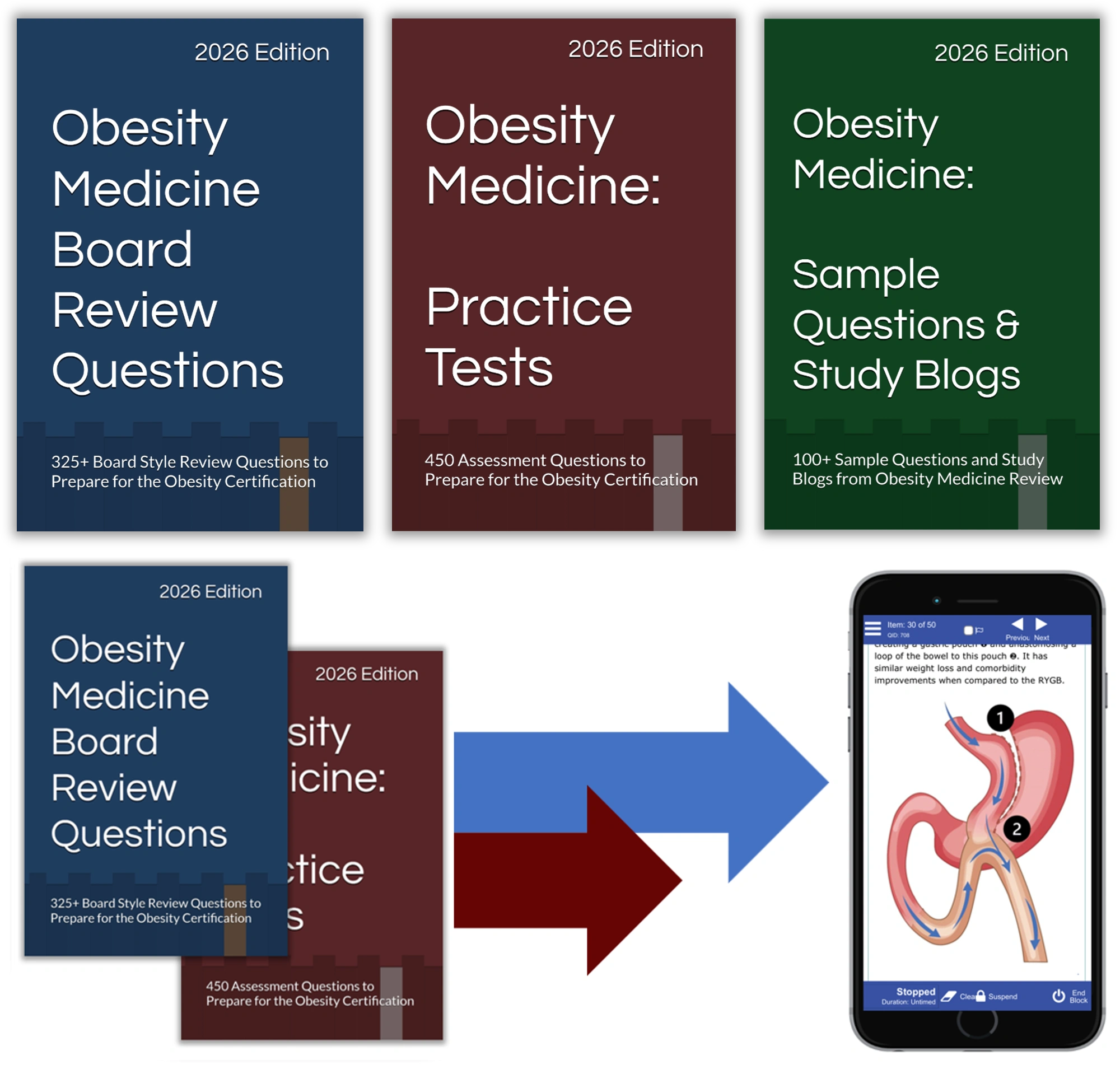
Now available: A full line of ABOM study resources with 775+ challenging questions in a mobile or book format. Access to both formats is available in a discounted Ultimate Package, which also includes a Pass Guarantee (if you fail the exam in 2026, you get the 2027 edition free), 50 bonus questions released in August, and the newest book, Obesity Medicine: Sample Questions and Study Blogs, which includes all the updated previous study blogs in a paperback format. Check it out here!
