

Nutritional therapy is a pillar of obesity management, and providers have numerous tools for measuring nutritional intake. Knowing which tools are most appropriate and accurate in different situations is important to study for the exam. Dietary monitoring assessment techniques can be divided into three categories: food frequency questionnaires, food recalls, and food records.
- Food records: One of the most common ways for patients to track intake is to keep a simple log. This could be as simple as writing down what meals they eat throughout the day or utilizing one of the numerous phone-based applications. Although simple, it can be time-consuming and cumbersome. Every meal and every snack is written down. Some patients enjoy this sort of comprehensive tracking, while others may despise it. However, the most limiting factor is accuracy. If a patient is told to track their intake and return in a week, you most likely will see a modified version of what they have been eating as the patient’s behavior changes when it is being monitored. Although this can be a great thing in terms of healthy behavioral change, as a provider, it can provide a facade of healthier-than-average eating patterns, as it is assumed they are doing well in this area. Literacy and motivation are also needed to complete this track. This method is preferred for those with memory issues as you record as you go and are not subject to mental recall, as will be discussed in other methods. As a note of importance, some patients may become fixated and develop compulsive behavior with food tracking applications. Therefore, this tool should be avoided in individuals with a history of these behaviors.
- Food recall: A 24-hour recall is a simple, in-office structured interview in which a trained interviewer (often a dietitian) will go through the previous 24-hour consumption of food and beverages, often in detail (how items were cooked, portion sizes, etc.). Automated versions are also now available via the National Cancer Institute, which helps streamline the process without utilizing additional resources. A 24-hour recall is most common, although other time intervals, such as 72 hours, may be utilized, although difficulty in remembering fine details may restrict its accuracy. This method is generally accurate, although it may not adequately reflect longer-term eating patterns; thus, it is often repeated over time. It is more likely to show behaviors toward food, potentially unmasking food binging or food aversions, compared with food records, which tend to show patterns over time. However, special events the day before or “last supper syndrome,” where patients eat an incidentally high caloric intake prior to seeking treatment for obesity, may cause erratic and inaccurate counts. Patients must have the intellectual bandwidth to recall in detail their food intake, so this may not be the best choice in those with syndromic obesity with cognitive deficits, albeit more attainable when compared to the food frequency questionnaire.
- Food frequency questionnaire (FFQ): This self-administered assessment provides a lot of information, without causing a lot of stress for patients. A list of commonly consumed foods is provided, and the respondent selects how frequently they have consumed each item within a specified period. An example question is shown below:
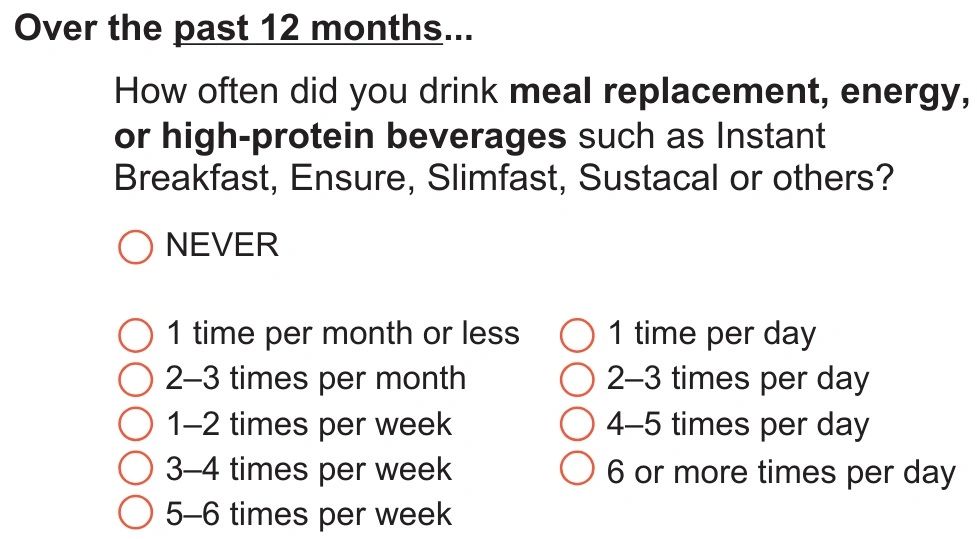
Although this does require memory to complete accurately, items that are frequently consumed or never consumed can be teased out quickly, allowing for education and dietary guidance. This dietary method is often used in research settings, as the checklist items can be customized to determine if there is an association between foods and the studied variable. Although it does not explain eating behaviors given its closed-ended questions, upon review by the clinician it does allow for discussion of food groupings such as vegetable, soda, or pasta intake. In addition, it is much less cumbersome than recording daily caloric intake, and provides a significant amount of information, although less granular.
In general, patients have trouble measuring dietary intake on a longer-term basis. However, even when used short-term, caloric intake can be an eye-opening experience. The little items and snacks throughout the day, “healthy” fast-food options, and sugar-sweetened beverages can add up in a big way. Will measuring dietary intake get simpler? As technology continues to develop, AI will likely take a lead role in dietary tracking. Although lacking perfection, currently there are a few apps that are available in which you can simply take a picture of your food, and the appropriate macronutrient and numerical caloric numbers populate. Bite counters may also become more popular as technology integrates with smartwatches counting the time you bring food to your mouth, rather than tracking the content directly, similar to a pedometer. For those who get bogged down or don’t enjoy tracking as much, this may be a good way to set simple goals (i.e., less than 100 bites per day, etc.). Regardless of what is in the technological pipelines, the ABOM boards will expect you to have a growing knowledge of nutrition, including dietary monitoring techniques as discussed above.
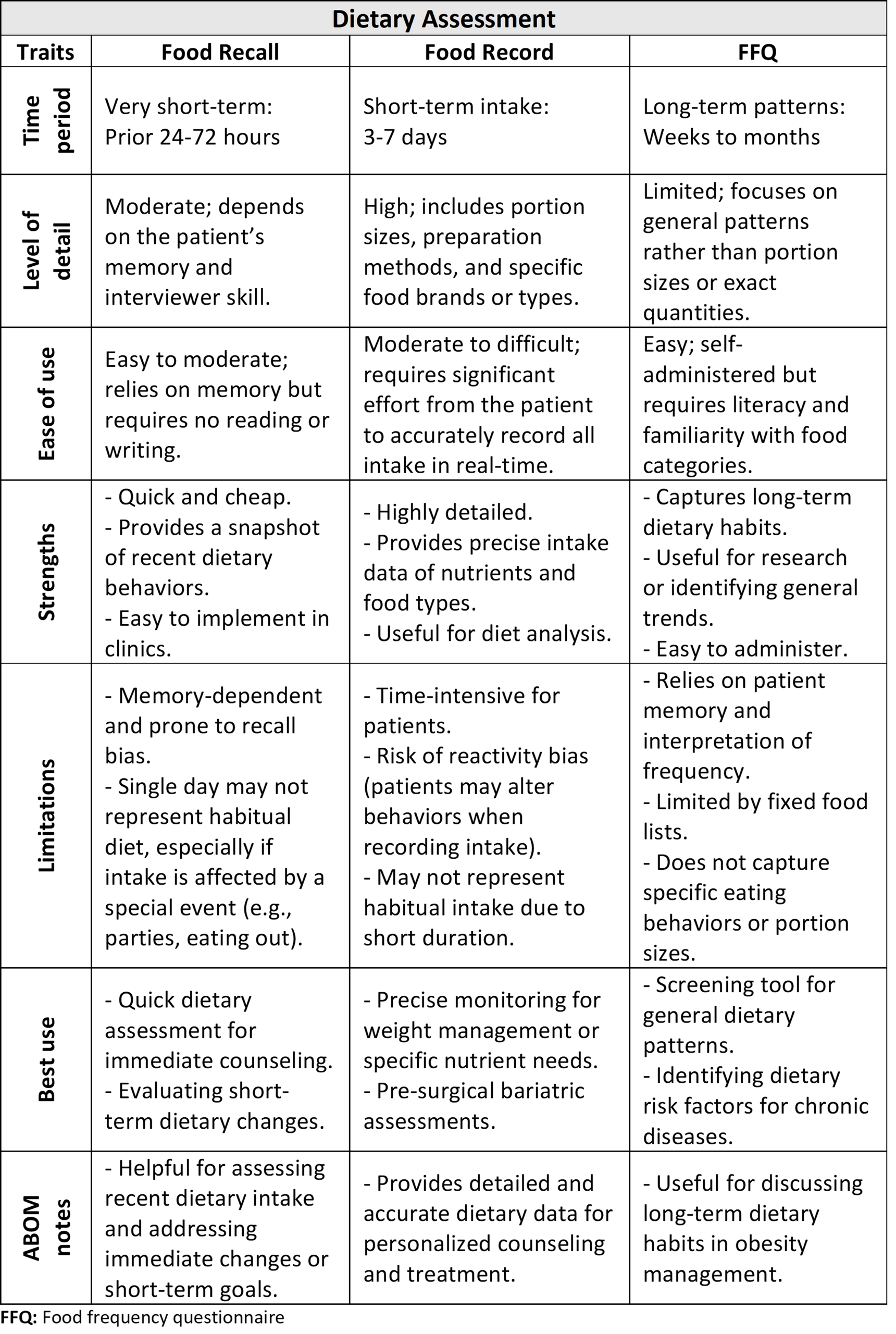
A summary table of the dietary intake measuring methods is described below:
Sample Question
A 15-year-old adolescent male is presenting to a dietitian to discuss healthy eating patterns. To get a better idea of what foods the patient is consuming, the dietitian had him fill out a 5-day food record prior to this appointment. She noticed more intake of fruits and vegetables on the food record than what the primary care physician had documented. What is the most likely cause of this discrepancy?
A. Altered eating behaviors
B. Fraudulent reporting of intake
C. Memory recall bias
D. Tracking weekdays only
E. Parental tracking inaccuracies
Next Week: Viral etiology of obesity
Upcoming: Metabolic-associated steatohepatitis and knowledge check-in
For more practice questions, check out the following:
- Obesity Medicine Board Review Questions (2026): Q 134.
- Obesity Medicine Practice Tests (2026): Qs 316, 362, and 446.
(Copyright 2026) Obesity Medicine Board Review Questions, LLC: obesitymedicinereview.com
Featured image: Modified from VectorStock (image license purchased)
Copyediting by Kelly Smith
Now available: A full line of ABOM study resources with 775+ challenging questions in a mobile or book format. Access to both formats is available in a discounted Ultimate Package, which also includes a Pass Guarantee (if you fail the exam in 2026, you get the 2027 edition free), 50 bonus questions released in August, and the newest book, Obesity Medicine: Sample Questions and Study Blogs, which includes all the updated previous study blogs in a paperback format. Check it out here!
