

Deficiencies of fat-soluble and water-soluble vitamins, minerals, total calories (marasmus), and protein (kwashiorkor) are commonplace on ABOM board review courses. From surgical malabsorption, very-low-calorie diets, medication interactions, eating disorders, or enteropathies, expect to see at least half a dozen questions in this high-yield test content area. So what do you need to know? Understand who is at risk, the symptoms, and how to prevent these deficiencies at a minimum. Where vitamins are absorbed and specific pathology is also fair game.
Vitamin B deficiencies will be spread over multiple blog posts. Today, we will dive into some of the more commonly tested associations to provide insight into how these may be tested. Starting with medications, there are a few that need to be considered due to their unique mechanisms:
- Metformin: If a patient with diabetes who has been taking metformin for years presents with bilateral lower extremity neuropathy, do not just assume this is diabetic neuropathy; metformin can prevent the absorption of B12, leading to similar symptoms. This reversible cause needs testing and treatment, especially before placing them on a weight-positive neuropathic medication such as pregabalin or gabapentin.
- Methotrexate: Another association is folate deficiency (B9) while taking methotrexate. Why would this show up on obesity medicine boards? Think about a patient who has secondary obesity from glucocorticoids, and you are placing them on glucocorticoid-sparing therapy and forget to supplement folic acid. They likely will return with macrocytic anemia or mouth ulcers.
Another reason for deficiencies may be malabsorptive procedures or complications related to the surgery, which can lead to depletion. Thiamine (B1) is a great example, as it can be depleted quickly. Although we often associate Wernicke’s with alcohol use disorder, a week or two of poor intake after metabolic and bariatric surgery could also cause similar clinical findings.
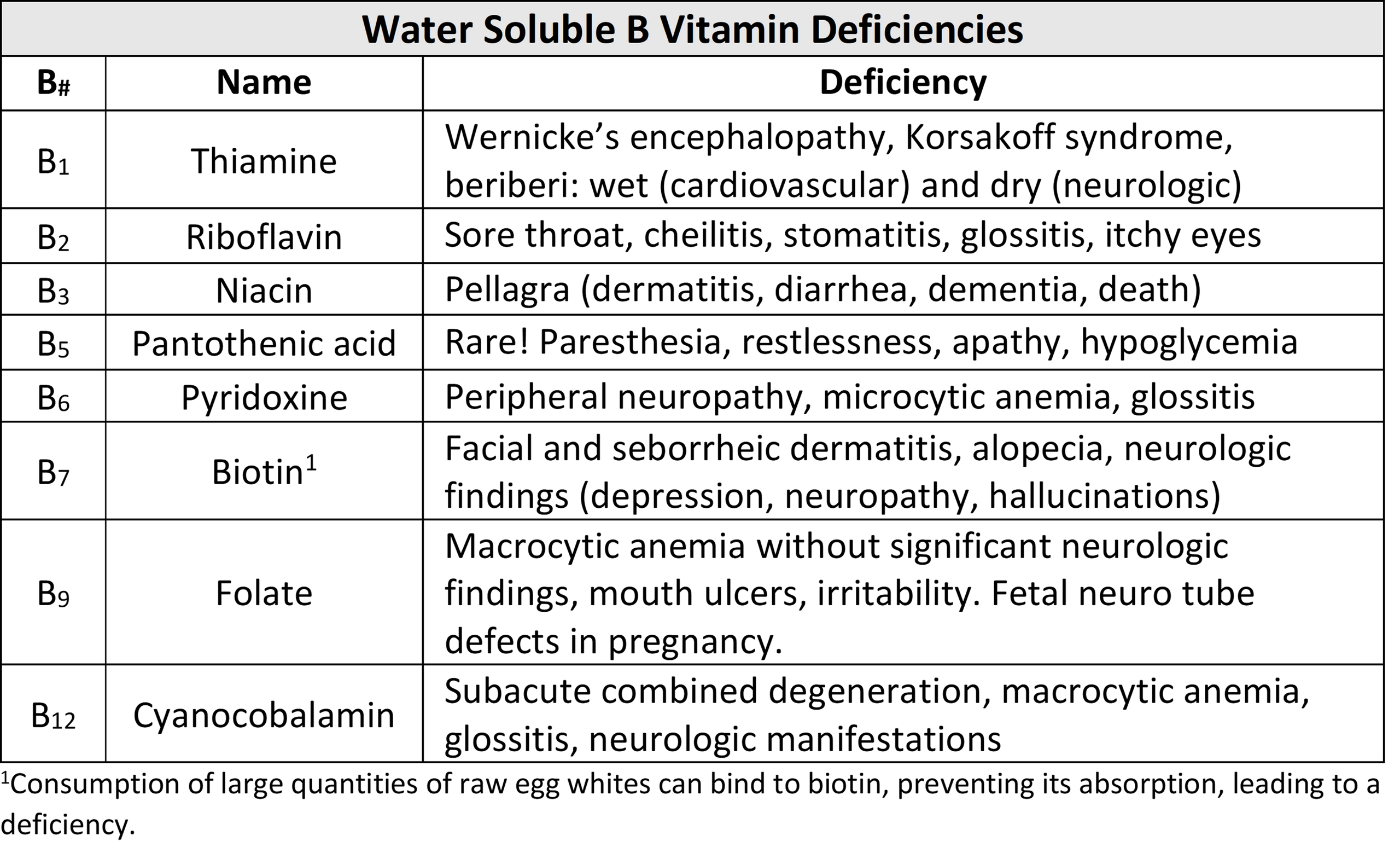
Thiamine deficiency causes different presentations, which often vary by chronicity. Some of the more common presentations are discussed below:
- Wet beriberi: High-output congestive heart failure, including cardiomegaly, cardiomyopathy, peripheral edema, and tachycardia
- Dry beriberi: Symmetric peripheral polyneuropathy (sensory and motor), mostly affecting distal extremities
- Wernicke’s encephalopathy: Ataxia, nystagmus, ophthalmoplegia, and confusion; considered reversible
- Korsakoff syndrome: A chronic neurological condition characterized by impaired short-term memory and confabulation; considered irreversible.
Finally, enteropathies must be considered as the location of gastrointestinal (GI) involvement may predispose to deficiencies. B vitamins are absorbed in different locations in the GI tract. The jejunum absorbs folate, vitamin B12 is absorbed in the ileum (with the help of the cofactor intrinsic factor produced by gastric parietal cells), and many other water-soluble vitamins are absorbed in the colon. Celiac disease and Chron’s disease can affect any area of the GI tract (although Chron’s disease favors the ileum), and autoimmune conditions such as pernicious anemia may decrease intrinsic factor.
For the ABOM boards, be familiar with symptoms of deficiency, and the names of specific vitamins (i.e., thiamine, niacin, etc.), as these will be used interchangeably, as summarized in the table below.
Sample Question:
A 44-year-old man with a history of a recent duodenal switch presents to the emergency department with vomiting and ataxia. If this vitamin deficiency is not corrected, which of the following may be the clinical outcome?
A. Osteoporosis
B. Cardiomyopathy
C. Mucosal bleeding
D. Severe diarrhea
E. Anosmia
Next Week’s Topic: Respiratory quotient and total energy expenditure
Upcoming Topics: Sleeve gastrectomy, and dietary changes and their effect on the lipid panel.
For more practice questions, check out the following:
- Obesity Medicine Board Review Questions (2026): Qs 35, 98, and 106.
- Obesity Medicine Practice Tests (2026): Qs 3, 70, 127, 153, and 166.
(Copyright 2026) Obesity Medicine Board Review Questions, LLC: obesitymedicinereview.com
Featured image: Modified from VectorStock (image license purchased)
Copyediting by Kelly Smith
Now available: A full line of ABOM study resources with 775+ challenging questions in a mobile or book format. Access to both formats is available in a discounted Ultimate Package, which also includes a Pass Guarantee (if you fail the exam in 2026, you get the 2027 edition free), 50 bonus questions released in August, and the newest book, Obesity Medicine: Sample Questions and Study Blogs, which includes all the updated previous study blogs in a paperback format. Check it out here!
