
Anyone practicing obesity medicine has seen lipedema, whether we recognized it or not. Often misdiagnosed as lymphedema, these two conditions have distinct physiologic etiologies and must be accurately identified.
I will admit that what is likely required for ABOM boards on this topic likely mirrors what is known about this condition, which is minimal. So, what do you need to know? First, identification is key, and secondly, recognizing critical clinical differences between this and lymphedema (see table below). Although this topic may not be as high yield as others, it is still essential clinically to diagnose accurately.
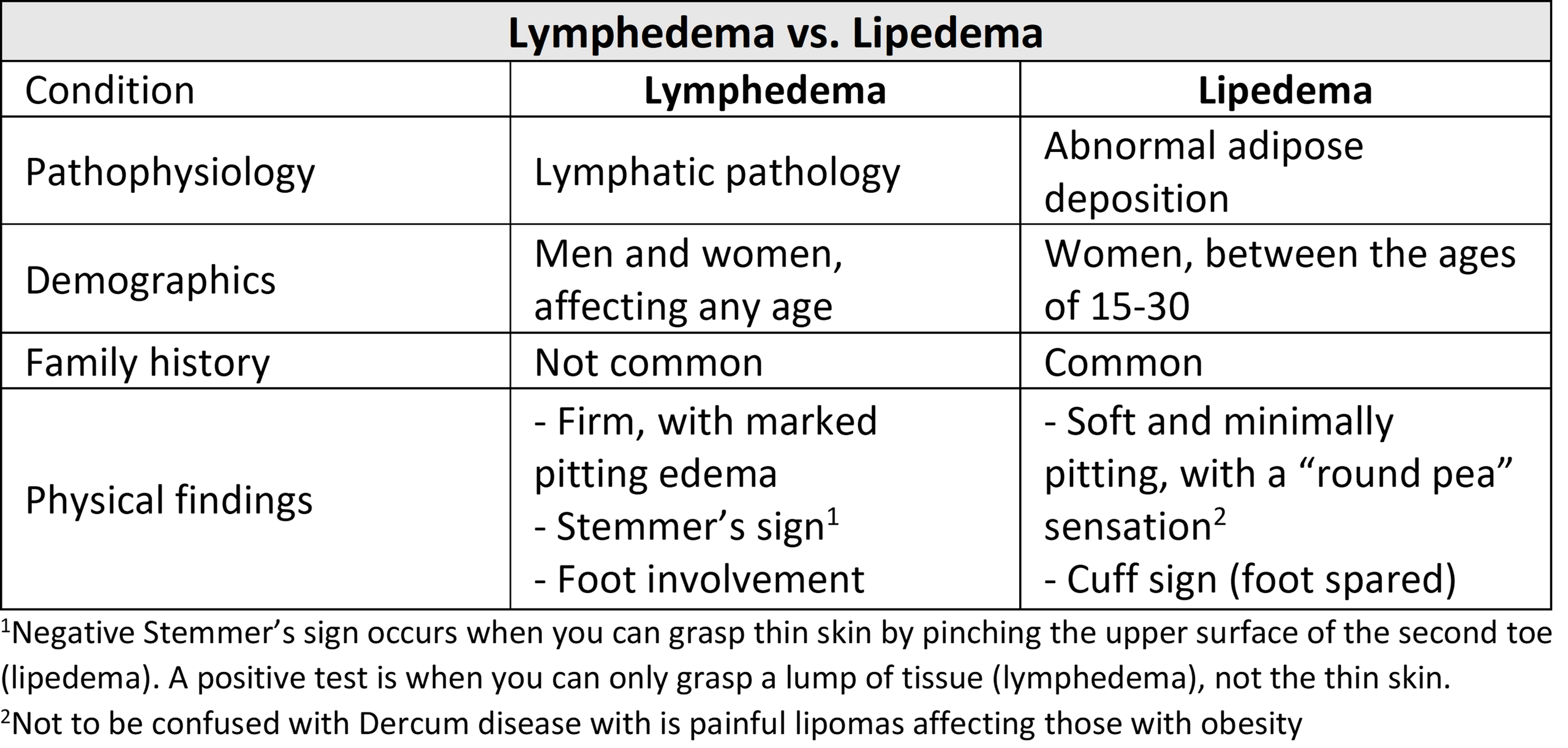
Lipedema is characterized by a disproportionate distribution of adipose tissue in the lower extremities (and less often, the arms) compared to the trunk, which can also be painful and easily bruise. It predominantly affects women and characteristically spares the hands and feet; this finding is often referred to as the “cuff sign,” as the adipose tissue from the extremities overlays, but does not affect, the distal extremities. This cuff sign is an important differentiating feature from lymphedema. Another key difference is Stemmer’s sign, which is positive when you are unable to pinch or lift the skin at the base of the second toe, indicating lymphedema. In lipedema, this sign is negative because the feet are typically spared, allowing the skin to be grasped.
A few other key differentiating features between lymphedema and lipedema include:
- Lymphedema: Pitting edema that affects the entire extremity (including foot or hand) and is often asymmetric between the extremities. Edema is caused by poor lymphatic flow, and thus, the fluid associated with it is generally higher in protein (causing pitting).
- Lipedema: Symmetrical extremity involvement (although later in the disease, it can be asymmetric). Fluid associated with this condition is primarily water (not high protein) and thus will not pit.
Unfortunately, lipedema is not curable. Diet and exercise will generally improve truncal obesity, but it is difficult to reduce the adipose tissue from the extremities affected with lipedema. Medical treatments for lipedema are limited, although liposuction is especially useful in the setting of painful or mobility-limited lower extremity fat. This procedure often improves the quality of life and is considered a medical necessity, not cosmetic, secondary to disability (although insurance may disagree).
Compressive techniques (similar to those used for lymphedema) and occupational therapy may also help with symptoms. Low-inflammatory dietary options, including the Mediterranean diet or plant-based nutritional plans, as well as supplements such as bioflavonoids and grape seed extract, may have some benefits, although studies are limited. These dietary options are unlikely to show up on test day.
Note: Another condition that has abnormal fat distribution is Cushing disease, which characteristically causes truncal obesity, with disproportionately thinner arms and legs. In addition, Dercum disease is a syndrome of multiple painful lipomas/nodularities affecting the torso and proximal extremities. Be able to distinguish these conditions!
The table below contrasts and compares the differences between two commonly tested diagnoses:
Sample Question
A 19-year-old woman presents to her family medicine physician and is requesting a referral to a lymphedema clinic. She states that since she was 15 years old, she has gained excessive weight that is most predominant in her lower extremities. She has a normal waist circumference and a BMI of 26 kg/m². Her lower extremities have a sensation of round peas when the fatty tissue is palpated. What other finding would be expected in this patient?
A. Decreased lymphatic flow
B. Positive cuff sign
C. Marked pitting edema
D. Eventual progression to arms
E. Positive Stemmer’s sign
Next Weeks Topic: Anastomotic Stricture Vs. Ulcer (RYGB complications)
For more practice questions, check out the following:
- Obesity Medicine Board Review Questions (2026): Qs 13 and 39.
- Obesity Medicine Practice Tests (2026): Qs 13, 69, and 255.
(Copyright 2026) Obesity Medicine Board Review Questions, LLC: obesitymedicinereview.com
Featured image: Adipocytes (modified): Connective Tissue Adipose (41066513194).jpg from Wikimedia Commons.
Copyediting by Kelly Smith
Now available: A full line of ABOM study resources with 775+ challenging questions in a mobile or book format. Access to both formats is available in a discounted Ultimate Package, which also includes a Pass Guarantee (if you fail the exam in 2026, you get the 2027 edition free), 50 bonus questions released in August, and the newest book, Obesity Medicine: Sample Questions and Study Blogs, which includes all the updated previous study blogs in a paperback format. Check it out here!
