

One of the most concerning adiposity-mediated comorbidities is malignancy. Obesity increases the risk of certain cancers significantly and is classified as an adiposopathy given the hormonal influence. In this blog, we will look at the different cancers associated with excess weight and some of the high-yield points needed for the exam.
Currently, the Centers for Disease Control and Prevention (CDC) identifies 13 cancers that are specifically associated with excess body weight. This number will likely increase as additional long-term studies are completed. Among the malignancies most strongly associated with obesity is endometrial cancer, which carries an approximately sevenfold increased risk compared with individuals at a healthy weight. Similarly, esophageal adenocarcinoma risk is approximately five times higher in individuals with class III (severe) obesity, and about two times higher in those with other obesity classes, compared to healthy-weight individuals.
The remaining obesity-associated cancers exhibit risk increases ranging from 10% to 200%, depending on the cancer type and degree of excess weight. The 13 cancers currently identified by the CDC as associated with excess weight are listed below:
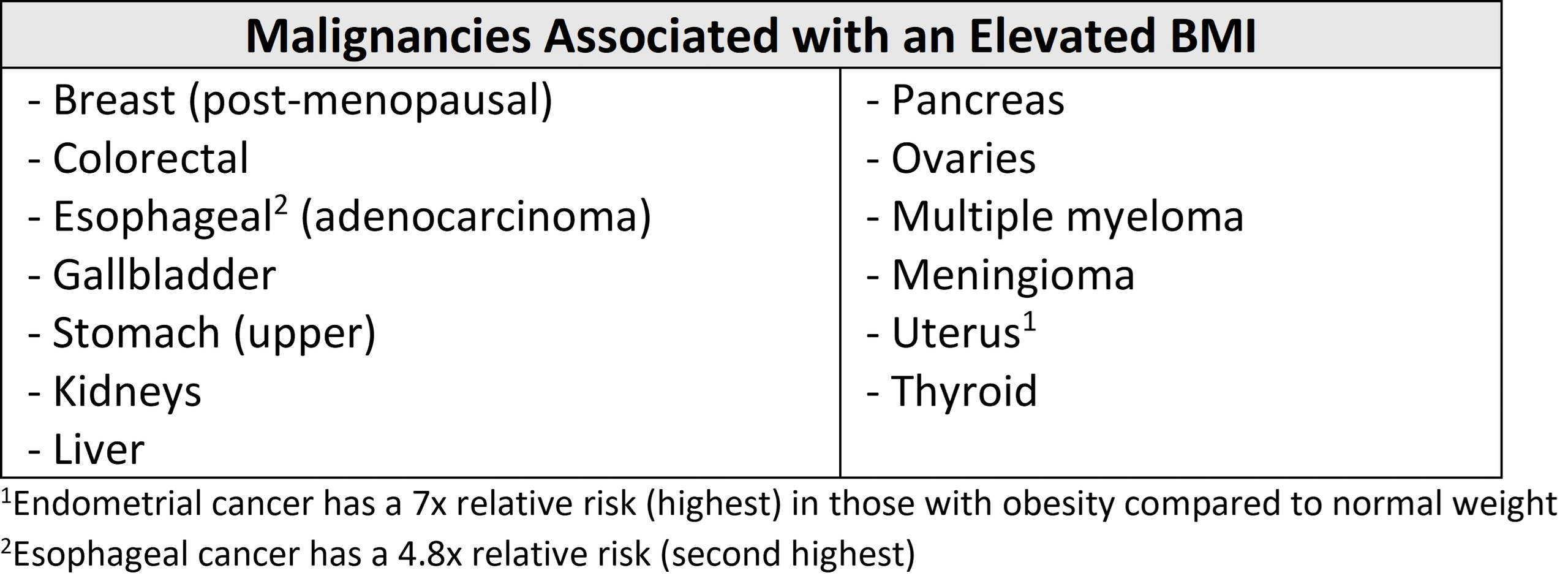
The pathophysiology underlying the increased cancer risk associated with obesity is likely multifactorial, involving several interconnected mechanisms.
Key theories include:
- Estrogen production by adipose tissue: Adipose tissue is a significant source of aromatase, an enzyme that converts androgens into estrogen. This may contribute to the development of estrogen-sensitive malignancies such as endometrial, ovarian, and estrogen receptor-positive breast cancer. Unopposed estrogen exposure is a well-established risk factor for these cancers. Individuals with excess adipose tissue are chronically exposed to higher levels of estrogen, thereby increasing their risk.
- Chronic inflammation and increased cellular turnover: Obesity is associated with a chronic inflammatory state, which promotes cellular turnover and may increase the risk of malignancy. For example, in Barrett’s esophagus, chronic inflammation leads to intestinal metaplasia, significantly increasing the risk of esophageal adenocarcinoma. Obesity is a known risk factor for gastroesophageal reflux disease, which further contributes to esophageal cancer risk, shown to be up to 5-fold higher in individuals with obesity. Similarly, systemic proinflammatory cytokines secreted by adipose tissue may predispose individuals to other malignancies.
- Hyperinsulinemia and insulin-like growth factor-1 (IGF-1): Elevated levels of insulin and IGF-1 are both independent risk factors for cancer. These are commonly seen in individuals with obesity and its associated comorbidities, such as type 2 diabetes, metabolic syndrome, and polycystic ovarian syndrome. Hyperinsulinemia is thought to exert a dose-dependent effect, contributing to the development of both estrogen-mediated malignancies (e.g., ovarian, endometrial, and breast cancers) and non-estrogen-related cancers, such as thyroid, colorectal, and prostate cancer.
- Adipokines and altered signaling pathways: While leptin is an important regulator of appetite and energy balance, it also promotes cell proliferation in the setting of excess adiposity. Elevated leptin levels may contribute to aberrant cellular growth and oncogenesis. Conversely, adiponectin, an anti-inflammatory adipokine with antiproliferative effects, is inversely correlated with adiposity, meaning that in obesity, adiponectin levels are reduced, limiting its protective benefits.
- Disruption of other cellular regulatory pathways: Obesity may also impair important cellular signaling mechanisms, such as the mammalian target of rapamycin (mTOR) and AMP-activated protein kinase (AMPK) pathways. Dysregulation of these pathways, both of which are involved in cell growth and metabolism, may further increase the risk of cancer development.
Unfortunately, cancers associated with excess weight continue to rise at a rate that parallels the increasing prevalence of obesity, while the incidence of nonadiposity-related cancers has decreased over the same period. In 2019 alone, nearly 5% of new cancer cases in men and 11% in women were attributed to excess weight, accounting for over 130,000 new cases. These numbers are expected to continue to rise.
Fortunately, weight loss appears to reduce the risk of obesity-related cancers, supporting the idea that this modifiable risk factor, when addressed aggressively, may help prevent one of the most serious complications of excess adiposity. Whether achieved through surgery, lifestyle modification, or antiobesity medications, even modest weight loss of 5% or more has been associated with clinically meaningful reductions in the risk of nearly all 13 obesity-associated cancers, including multiple myeloma and malignant meningiomas. It is worth noting that while most meningiomas are benign, a malignant subtype exists, which carries a more aggressive course and is the one associated with the higher prevalence in those with obesity.
Excess weight not only increases the risk of developing cancer but also worsens prognosis and recurrence risk in patients after treatment. For example, obesity is associated with an increased lymphedema risk in breast cancer survivors, higher rates of urinary incontinence after radical prostatectomy, and a greater risk of local recurrence following treatment of rectal cancer. Additionally, severe obesity has been linked to a 50% increase in cancer-related mortality compared to individuals at a healthy weight.
Another important area of concern is cancer screening in patients with obesity. While this blog has focused on the rising cancer incidence and treatment complications in this population, it should also serve as a call to action to promote appropriate cancer screening. Unfortunately, several barriers exist:
- Pap smears may be technically challenging and potentially uncomfortable in patients with obesity, leading to lower screening rates.
- Mammograms tend to have reduced sensitivity in individuals with higher body fat, often requiring additional imaging or more frequent follow-up.
- Colonoscopy can be more technically difficult to perform in patients with obesity, contributing to missed or delayed screenings.
Improving access to care and tailoring cancer screening strategies for individuals with obesity are essential steps in reducing cancer-related morbidity and mortality in this high-risk population. For both the ABOM exam and clinical practice, it is important to understand the impact of adiposity on cancer risk, which underscores the need to ensure that patients are up to date on recommended screenings. Additionally, clinicians should be familiar with the pathophysiologic mechanisms that link excess weight to cancer and be able to identify the specific malignancies most strongly associated with obesity.
Sample Question
A 47-year-old woman presents for a comprehensive metabolic and bariatric surgery consultation. Her BMI has consistently been over 50 kg/m² for the past ten years, which she attributes to pregnancies and genetics. She has a family history of endometrial cancer in her mother and prostate cancer in her father. Per the Centers for Disease Control and Prevention, aggressive weight loss will likely reduce the risk of malignancy affecting which of the following areas?
A. Thyroid
B. Lymph nodes
C. Lung
D. Skin
E. Oral
Next Week: Transoral Reduction Outlet Procedure
Following Week: Wilson-Turner Syndrome
Upcoming: Monthly Knowledge Check. This is a review checklist of must-know items for ABOM exams based on the previous four blog topics (Cushing’s Syndrome, Wilson-Turner Syndrome, Transoral Reduction Outlet Procedure, Obesity and Cancer). In addition, this will include a brief explanation of the correct answers to previous sample questions.
For more practice questions, check out the following:
- Obesity Medicine Board Review Questions (2026): Q 272.
- Obesity Medicine Practice Tests (2026): Qs 149 and 266.
(Copyright 2026) Obesity Medicine Board Review Questions, LLC: obesitymedicinereview.com
Featured image: Modified from VectorStock (image license purchased)
Copyediting by Kelly Smith
Now available: A full line of ABOM study resources with 775+ challenging questions in a mobile or book format. Access to both formats is available in a discounted Ultimate Package, which also includes a Pass Guarantee (if you fail the exam in 2026, you get the 2027 edition free), 50 bonus questions released in August, and the newest book, Obesity Medicine: Sample Questions and Study Blogs, which includes all the updated previous study blogs in a paperback format. Check it out here!
