
Alström syndrome is a rare genetic cause of early-onset obesity, affecting just one in a million individuals. Due to its rarity and variability in symptoms, however, it has likely been underdiagnosed. As more readily available genetic obesity panels are utilized, the rate of diagnosis is likely to increase. The ABOM will expect you to have a basic understanding of inheritance patterns, clinical and laboratory findings, and differentiating features of genetic etiologies of obesity. Although you do not have to be an expert in genetics, you will be required to have a foundational knowledge of basic concepts. Today’s blog will cover the highlights of Alström syndrome.
Alström syndrome is inherited in an autosomal recessive pattern, with a defect occurring in the ALMS1 gene. This gene affects the function of primary cilia, leading to its wide phenotypical variance. To understand the phenotypical characteristics of Alström syndrome, it will be helpful to refresh on the role of cilia, as Alström syndrome is a ciliopathy, similar to Bardet-Biedl syndrome (click here for more on BBS). Cilia play a large role in organ development and function. They are heavily involved in cell signaling during the embryonic stages as well as with cellular division and cell cycle regulation. For example, they are involved in the development and function of cardiac cells. Dysfunction can lead to structural and functional heart defects, such as dilated cardiomyopathy, a hallmark of Alström syndrome. Cilia are also essential components of photoreceptor cells in the retina and hair cells in the cochlea. On an organ level, they assist with water homeostasis in the kidneys and mucus clearance in the respiratory tract, to name a few.
The ALMS1 gene is a big gene, coding for over 4,000 amino acids. Therefore, depending on the defect within this gene (deletion, insertion, nonsense mutations, etc.), wide variations of disease penetrance can be observed. However, there are some common findings that help define the manifestations of this disease:
- Cone-rod dystrophy
- Sensineural hearing loss
- Dilated cardiomyopathy
- Endocrinopathies such as type 2 diabetes with hyperinsulinemia and hypertriglyceridemia
- Post-pubertal short stature with truncal obesity
Symptoms generally begin in infancy. Cone-rod dystrophy is often seen in the first few weeks of life, obesity develops within the first 1-2 years, 90% will develop some degree of hearing loss within the first decade, and progressive pathological organ involvement continues with age. The liver, lungs, and kidneys can also be affected to varying degrees. With no specific treatment available, life span generally does not exceed 50 years of age and mortality often results as a complication of cardiomyopathy which affects two-thirds of patients with Alström syndrome.
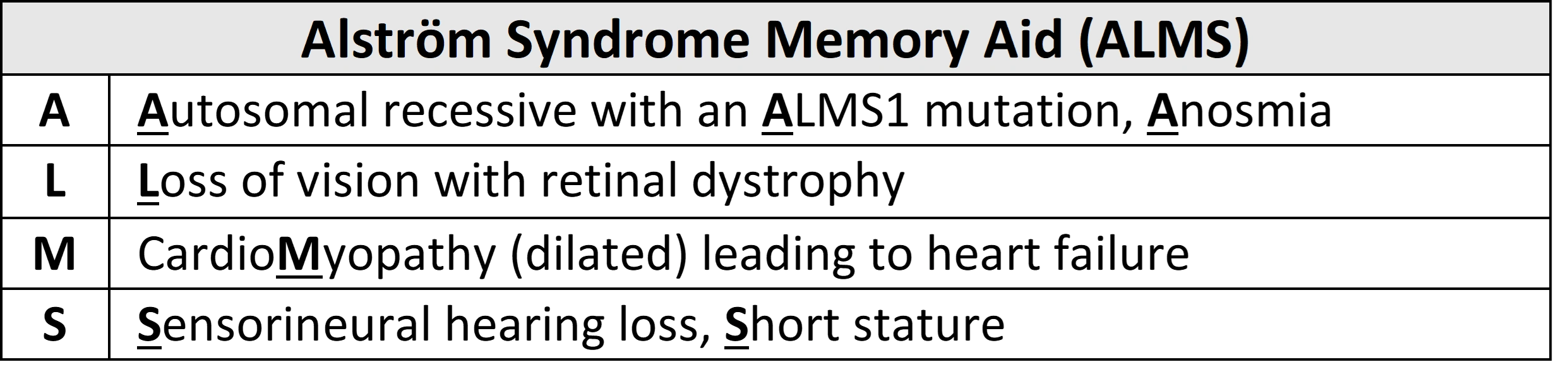
Having a basic knowledge of the common symptoms and being able to differentiate it from other genetic etiologies of early-onset obesity is key. Knowing its inheritance pattern and the gene affected is also testable. The table below summarizes the high-yield points in a mnemonic
Sample Question
A 6-year-old girl is being evaluated for early-onset hyperphagia and obesity. The patient wears glasses and has delayed speech. Acanthosis nigricans is noted on the nap of her neck. A genetic panel is ordered and a defect in the ALMS1 allele is identified. Which of the following is a potential finding of this disease?
A. Tall stature
B. Polydactyly
C. Dilated cardiomyopathy
D. Large earlobes
Next Week: Ketogenic diet
Upcoming: Everything to know about metformin and Knowledge Check
For more practice questions, check out the following:
- Obesity Medicine Board Review Questions (2026): Qs 41 and 60.
- Obesity Medicine Practice Tests (2026): Qs 120 and 341.
(Copyright 2026) Obesity Medicine Board Review Questions, LLC: obesitymedicinereview.com
Featured image: Modified from VectorStock (image license purchased)
Copyediting by Kelly Smith
Now available: A full line of ABOM study resources with 775+ challenging questions in a mobile or book format. Access to both formats is available in a discounted Ultimate Package, which also includes a Pass Guarantee (if you fail the exam in 2026, you get the 2027 edition free), 50 bonus questions released in August, and the newest book, Obesity Medicine: Sample Questions and Study Blogs, which includes all the updated previous study blogs in a paperback format. Check it out here!
