
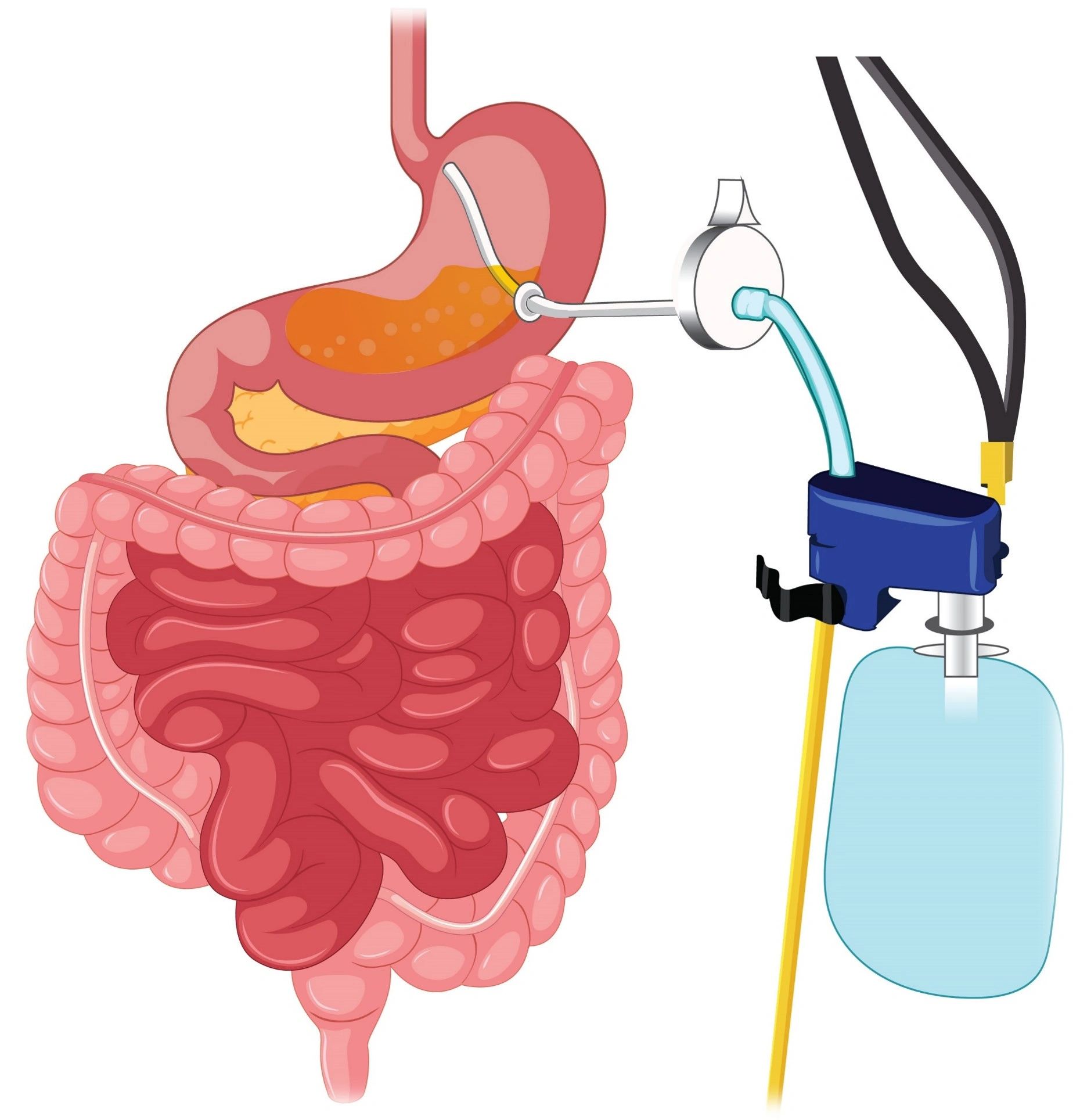
The Aspire Assist® device is one of the most unique weight loss apparatuses. Unfortunately, due to financial hardships post-COVID, the company has discontinued operations as of February 2022. However, the Aspire Assist® device may still show up on test day, given that there are patients out there who may have had this device as part of their obesity surgical history. Similar to those who had the lap band procedure, it is still important to understand these procedures, although they have fallen out of favor. And who knows, maybe another company will pick this up in the future in an attempt to carry this weight-loss oddity even further.
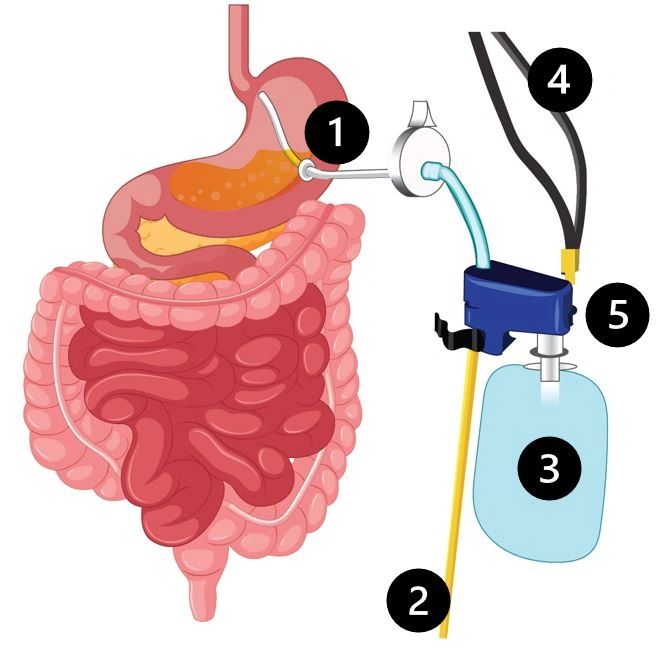
Surgical bulimia is the underlying mechanism behind the Aspire Assist® device. The patient would undergo an endoscopic procedure in order to have a gastrostomy tube placed ❶. This tube would connect to an external apparatus that the patient would carry with them ❺ attached to a lanyard ❹ in order to drain 30% of calories ingested 30 minutes after a meal. Essentially, after eating, you would go to the bathroom and aspirate (via gravity, not suction) the contents of the recent meal into the toilet ❷. It had a reservoir bag ❸ that was filled with water and could be squeezed to flush the port, as shown.
This aspiration device carried a broader BMI indication range (35-55 kg/m² ). In contrast to the gastric balloons, which have a 6-8 month lifespan, the aspiration device had a long-term indication for use. The aspiration device had similar contraindications to other percutaneous endoscopic gastrostomy tubes. It was also contraindicated in those with eating disorders, including night eating syndrome, bulimia, or binge eating disorder. In addition, the patient must be able to logistically perform the aspiration (scheduling, mental capacity, time commitment, etc.) to achieve weight loss success.
The aspiration device actually had some decent efficacy associated with it. According to the PATHWAY study, patients lost and maintained an average of 14-18% of their total body weight over the 4-year study period, with 70% of participants able to maintain a weight loss of 10% or more. It was also generally safe, with only a few complications that were resolved with device removal.
Although it is a relatively unusual way to lose weight, I am always open to safe, long-term, proven, and approved methods for weight loss. Given the complexity of various etiologies leading to weight gain, I am grateful for the availability of different tools, medications, and procedures that enable us to tailor our approach to combat this disease in customized ways for our patients. This procedure may have worked well for some, while a hard sell for others. Regardless, the pursuit of finding effective ways to treat obesity is commendable.
Sample Question:
A new aspiration device is under development in a research trial. A patient with which of the following conditions would be a poor candidate for this study?
A. Body mass index of 51 kg/m²
B. Significant mental disability
C. A history of multiple C-sections
D. Paraplegia of lower extremities
Next Week: Body fat measurements (calipers vs. DXA, etc.)
Upcoming: Pradar-Willi vs. Angelman.
For more practice questions, check out the following:
- Obesity Medicine Board Review Questions (2026)
- Obesity Medicine Practice Tests (2026)
(Copyright 2026) Obesity Medicine Board Review Questions, LLC: obesitymedicinereview.com
Featured image: Image custom-created. Copyright owned by Kevin Smith, DO.
Copyediting by Kelly Smith
Now available: A full line of ABOM study resources with 775+ challenging questions in a mobile or book format. Access to both formats is available in a discounted Ultimate Package, which also includes a Pass Guarantee (if you fail the exam in 2026, you get the 2027 edition free), 50 bonus questions released in August, and the newest book, Obesity Medicine: Sample Questions and Study Blogs, which includes all the updated previous study blogs in a paperback format. Check it out here!
