
It is pretty impressive that we have numerous hormones secreted throughout the gastrointestinal tract (CCK, GIP, GLP-1, OXM, and PYY) aimed at reducing/balancing the one hormone that makes us hungry, ghrelin. This potent orexigenic stimulator of hunger acts via the NPY/AgRP receptors in the brain and, to a lesser extent, via the vagal nerve, to decrease energy expenditure and increase energy consumption.
So, what do you need to know for ABOM boards regarding this hormone? A lot actually, so bear with me. This is low-hanging fruit for exams and also fundamental to understanding how we can help patients control appetite. Make sure you understand and commit the following concepts to memory:
- Production: Ghrelin is mainly produced and secreted by cells in the gastric fundus and body (and to a lesser extent in the duodenum). This is why patients who undergo a sleeve gastrectomy, where 80% of the stomach is removed (i.e., 80% of the cells that produce ghrelin), rarely complain of hunger.
- Increased levels: Think about what makes us hungry: fasting, stress (stress-eating), and sleep deprivation (this includes poor quality of sleep in the setting of OSA); all increase ghrelin levels.
- Suppressed levels: A stretched stomach, as in the setting of gastroparesis, cellulose and citric acid hydrogel or other three-dimensional volume occupying matrixes (e.g. Plenity®, and most recently Epitomee®, expected to be available in 2026), post-meal, weight gain (leptin counters ghrelin- see below), carbohydrates (short-acting, fast rebound), protein (long-acting), vagotomy, and sleeve gastrectomy decrease ghrelin production.
Not only do other hormones within the gastrointestinal tract counter ghrelin’s effects, but also leptin, produced by the adipocytes, is a potent nemesis of ghrelin, and one of the few beneficial effects of fat cells. Therefore, with weight gain (more adipocytes = increased leptin), ghrelin is inhibited, compared to weight loss (fewer adipocytes = less leptin), where ghrelin increases. This is one mechanism that explains why patients eventually plateau with weight loss.
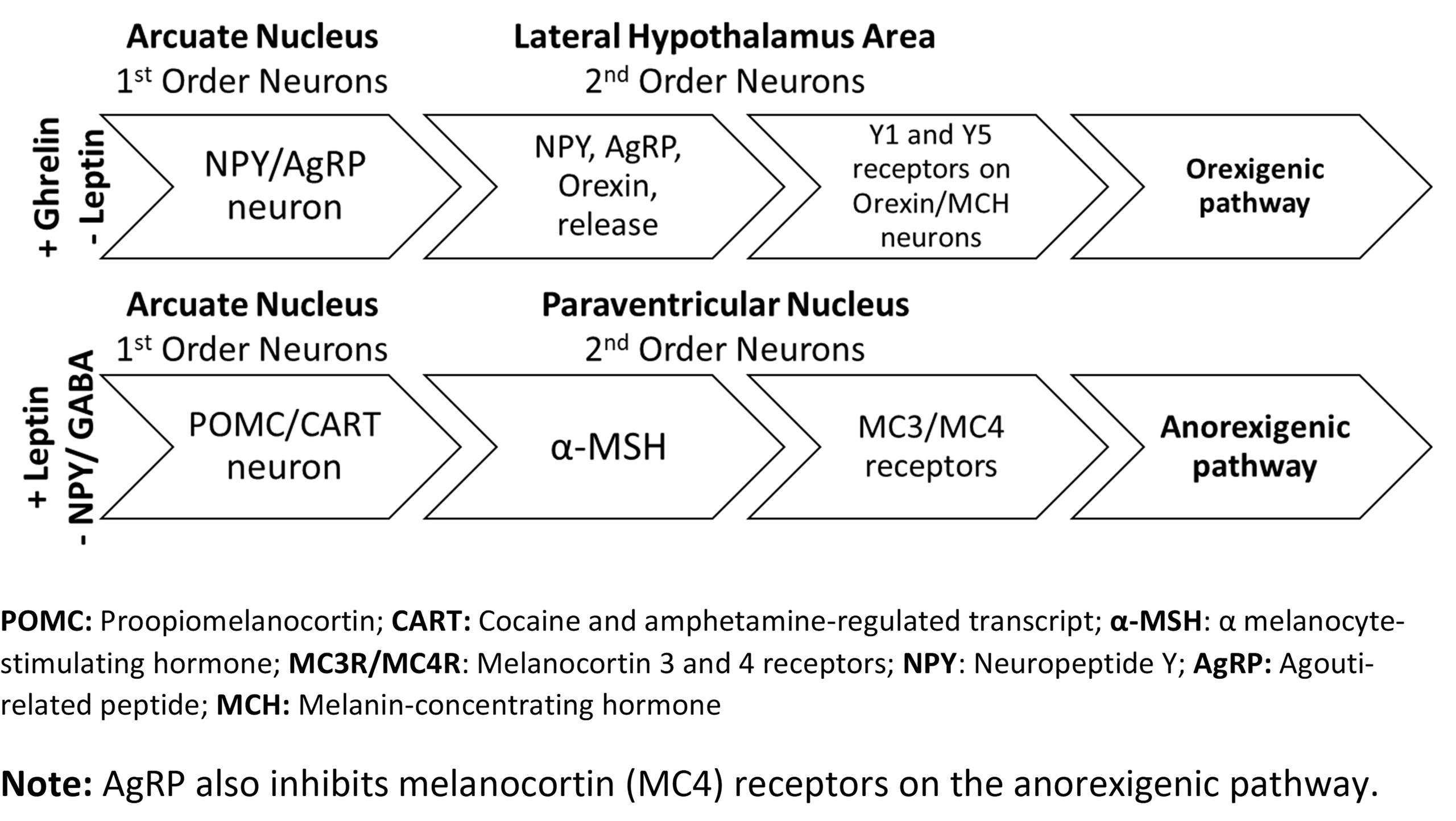
Finally, know the common orexigenic and anorexigenic pathways. We will go into more details later, but this is a bird’s-eye view of where ghrelin plugs into the central nervous system. Understand that ghrelin has a strong stimulatory effect on the orexigenic (i.e., hunger) pathway via the first and second-order neurons in the hypothalamus, whereas leptin (from adipocytes) not only inhibits that pathway but stimulates the anorexigenic pathway.
You will eventually need to memorize this entire pathway for boards:
Sample Question:
A 33-year-old woman recently underwent a sleeve gastrectomy and is losing weight appropriately. She is most impressed by the decreased appetite she has, irrespective of meals, which has helped in maintaining a significant calorie deficit. The hormone that is responsible for her decreased appetite initially acts on what area of the brain?
A. Dorsal vagal complex
B. Amygdala
C. Nucleus of the tractus solitarius
D. Arcuate nucleus
E. Lateral hypothalamus
Next Week’s Topic: Orlistat
For more practice questions, check out the following:
- Obesity Medicine Board Review Questions (2026): Qs 14, 42, 62, and 71.
- Obesity Medicine Practice Tests (2026): Qs 20, 49, 363, and 431.
(Copyright 2026) Obesity Medicine Board Review Questions, LLC: obesitymedicinereview.com
Featured image: Modified from VectorStock (image license purchased); Orexogenic/Anorexigenic pathway diagram: (© Kevin Smith, DO)
Copyediting by Kelly Smith
Now available: A full line of ABOM study resources with 775+ challenging questions in a mobile or book format. Access to both formats is available in a discounted Ultimate Package, which also includes a Pass Guarantee (if you fail the exam in 2026, you get the 2027 edition free), 50 bonus questions released in August, and the newest book, Obesity Medicine: Sample Questions and Study Blogs, which includes all the updated previous study blogs in a paperback format. Check it out here!
