
Although it may not be the most thrilling ABOM blog, a more in-depth review of receptors will be valuable for exam preparation. Memorizing the location and function of various receptors is a rote task, but don’t expect simple, first-order questions on these topics. You likely will be tested on your understanding of more nuanced receptor-related concepts. For the exam, it’s important to know where these receptors are located and what roles they play, not just the hormones associated with them. Let’s dive into some of the more notable receptors:
- Oxyntomodulin (OXM): Recall that OXM is one of the meal-terminating, anorexigenic hormones released from L-cells in the distal small intestine and colon in response to food intake. It is co-secreted with GLP-1 and activates two distinct receptors. First, OXM binds to the GLP-1 receptor, just like GLP-1 itself. This enhances GLP–1–mediated effects, including suppression of appetite and inhibition of postprandial glucagon secretion, thereby reducing hepatic gluconeogenesis. Second, OXM also activates the glucagon receptor, which promotes gluconeogenesis and increases blood glucose levels, a seemingly contradictory effect. However, the GLP-1 receptor activation is more potent, and overrides the glucagon-mediated hyperglycemic effects. For the exam, know when OXM is released, which cells secrete it, and that it activates both GLP-1 and glucagon receptors and their downstream effects.
- Cholecystokinin (CCK): This hormone is released primarily in response to the intake of fat, and to a lesser extent protein, by I-cells in the duodenum and jejunum. It acts on two similarly named but functionally distinct receptors. CCK1 receptors (also known as CCK-A) are located in the gastrointestinal tract and function to slow gastric emptying and stimulate gallbladder contraction. CCK2 receptors (also known as CCKB) are found primarily in the brain, where they act centrally to increase satiety and reduce appetite.
- Peptide YY (PYY): Secreted by L-cells in the distal small intestine, colon, and rectum, PYY acts peripherally by antagonizing Y2 receptors in the gastrointestinal tract, where it slows gastric emptying and intestinal motility, a role it shares with GLP-1. Centrally, PYY also binds to inhibitory receptors on NPY/AgRP neurons in the hypothalamus, leading to suppression of hunger.
- Pancreatic polypeptide (PP): Although not secreted from the intestines but rather the F cells of the pancreas in response to food, this hormone activates Y4 receptors throughout the gut leading to slowing of gastric emptying, as well as Y4 receptors found in the hypothalamus where it inhibits NPY expression.
These receptors are summarized in the table below.
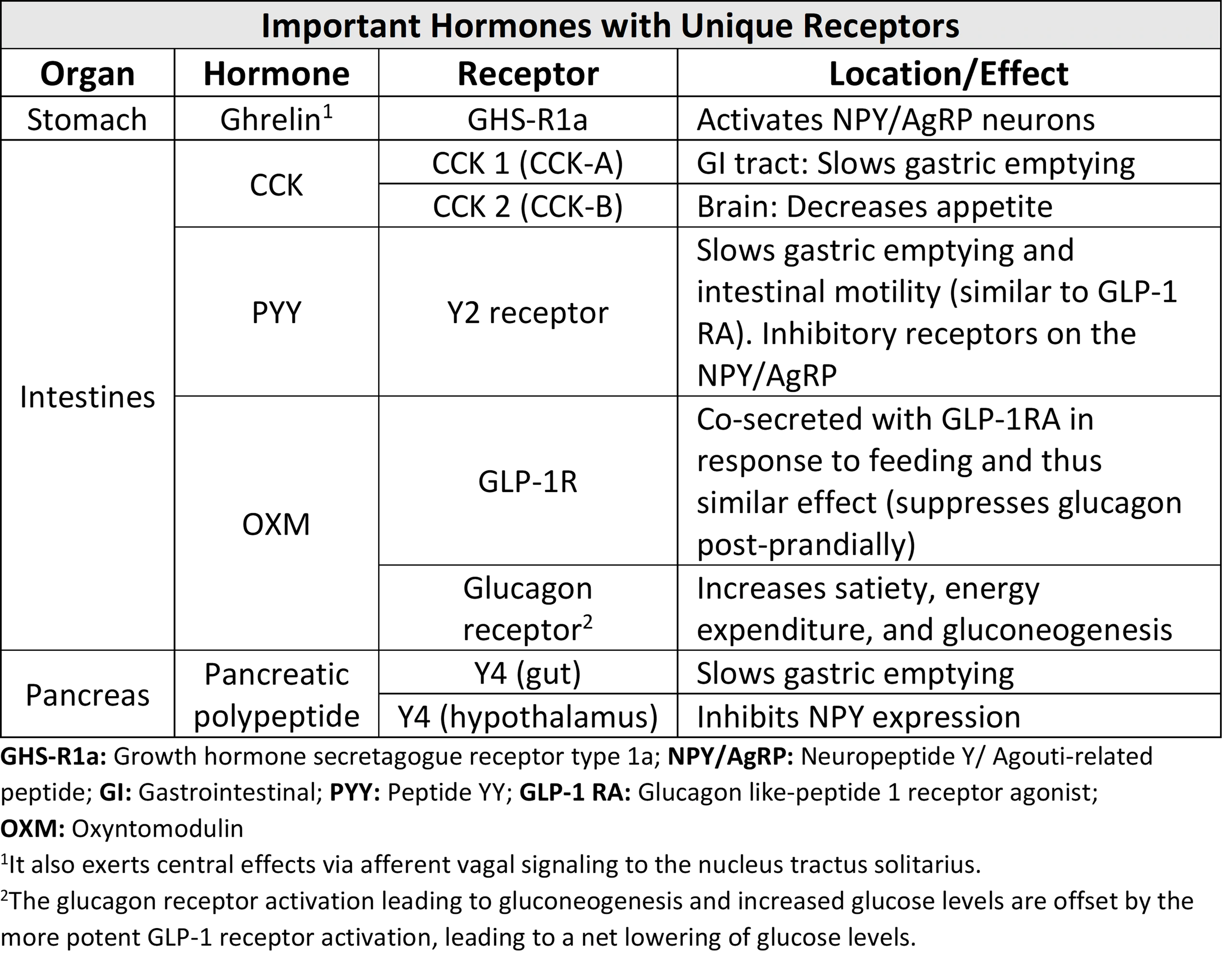
Although some receptor names are intuitive for which hormones they accompany (e.g., CCK), others, such as Y2 and Y4, are less so. Be sure to have these distinctions clearly organized in your mind by exam day.
Now, we will move on to centrally acting hormones and their related receptors. Review the central antagonizing systems if you are not familiar with these (found in a blog here) prior to reading on. A diagram that will be referenced is shown below.
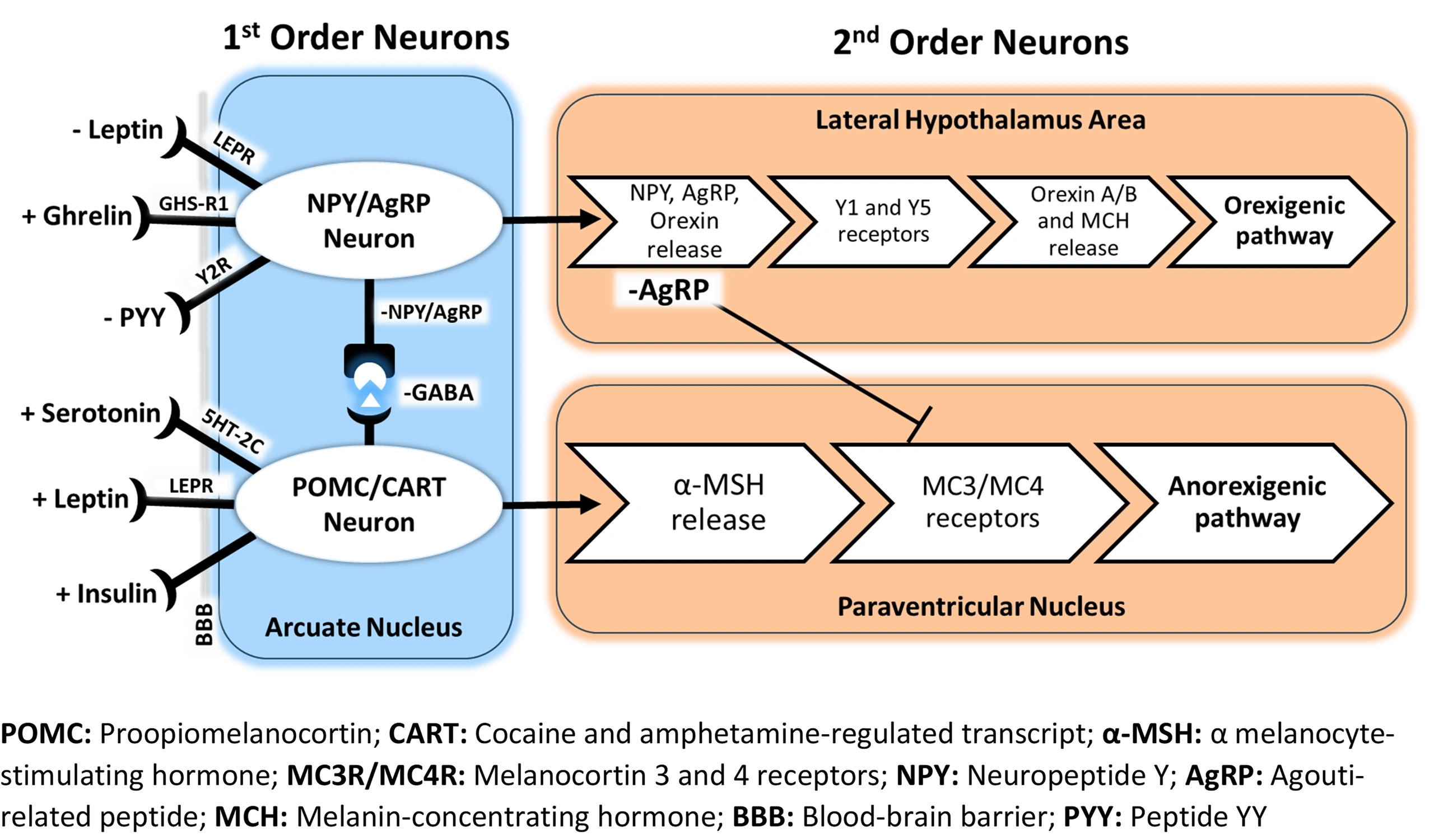
The diagram above illustrates the two primary hypothalamic pathways involved in appetite regulation: the NPY/AgRP orexigenic pathway (which stimulates hunger) and the POMC/CART anorexigenic pathway (which suppresses hunger). Pay close attention to the receptor names. Notably, 5-HT2C is a serotonin receptor subtype that was targeted by lorcaserin (Belviq®), a now-withdrawn anti-obesity medication removed from the market due to an increased incidence of cancer observed in a cardiovascular safety trial.
Also of interest is insulin, which exerts a central anorexigenic effect. Although insulin is often considered obesogenic due to its peripheral actions, it is important to recognize that both insulin and leptin function as long-acting central anorexigenic hormones. Unfortunately, individuals with peripheral insulin resistance often experience central insulin resistance as well, which can blunt this beneficial satiety-promoting effect.
Additionally, note that AgRP, an orexigenic neuropeptide, is released centrally and inhibits second-order neurons in the anorexigenic pathway by antagonizing the MC3 and MC4 receptors.
Why does central receptor function matter? Many pathological conditions affect these receptors. For example, MC4R deficiency is the most common monogenic cause of obesity. When the MC4 receptor cannot be activated, or is insufficiently activated, the anorexigenic pathway fails to engage fully, leading to reduced satiety, decreased energy expenditure, and ultimately weight gain. In contrast, in conditions such as leptin receptor deficiency or POMC mutations, medications like setmelanotide, an MC4R agonist, work by directly stimulating these receptors, thereby bypassing upstream defects.
Finally, observe the role of the GABA receptor on the POMC/CART pathway. Normally, activation of orexigenic NPY/AgRP neurons (for example, by ghrelin) promotes appetite both directly and indirectly by releasing GABA, which inhibits the anorexigenic POMC/CART neurons. In this way, GABA acts like a brake on the satiety pathway. Topiramate acts on this GABAergic system, not by simply stimulating or inhibiting GABA, but by modulating GABA receptor activity. By enhancing GABA receptor activity on POMC neurons, it helps lift this “brake,” thereby promoting activation of the anorexigenic (satiety) pathway independent of NPY/AgRP input. This shift in signaling balance amplifies anorexigenic tone and contributes to weight loss.
Understanding the central regulation of appetite through the NPY/AgRP (orexigenic) and POMC/CART (anorexigenic) pathways is essential for the ABOM exam. You should be familiar with key receptors, their roles, and where pharmacologic treatments have their effect. Expect questions that test your ability to integrate hormone function with receptor activation or inhibition and how these interactions influence hunger, satiety, and energy balance. Memorizing hormone names is not enough; understand the receptor-level mechanisms and pathophysiological implications for exam success.
Sample Question:
A 37-year-old woman is experiencing a prolonged layover at an airport and has not eaten for over 12 hours. She begins to feel intense hunger, and her stomach audibly growls. In addition to the physical symptoms, she reports feeling more irritable and distracted. The hormone responsible for this person’s findings most likely causes activation of which of the following receptor mechanisms?
A. GABA receptor activation on the POMC/CART neuron
B. Direct inhibition of the MC3/MC4 receptor
C. Y2R activation in the central nervous system
D. GHS-R1 inhibition on the first-order neurons
(Answer and explanation will be provided in an upcoming monthly Knowledge Check.)
Next Week: Guideline-based care: Reviewing the USPSTF ABOM-recommended resource
Following Week: Monthly Knowledge Check. This is a review checklist of must-know items for ABOM exams based on the previous four blog topics (Epitomee, CBT vs MI, vital hormone receptors, USPSTF recs). In addition, this will include a brief explanation of the correct answers to previous sample questions.
Upcoming: Cushing’s Syndrome, Wilson-Turner Syndrome, Transoral Reduction Outlet Procedure, Obesity and Cancer
For more practice questions, check out the following:
- Obesity Medicine Board Review Questions (2026): Qs 8 and 11.
- Obesity Medicine Practice Tests (2026): Qs 22, 37, 71, 84, 231, 353, and 354.
(Copyright 2026) Obesity Medicine Board Review Questions, LLC: obesitymedicinereview.com
Featured image: Modified from VectorStock (image license purchased)
Copyediting by Kelly Smith
Now available: A full line of ABOM study resources with 775+ challenging questions in a mobile or book format. Access to both formats is available in a discounted Ultimate Package, which also includes a Pass Guarantee (if you fail the exam in 2026, you get the 2027 edition free), 50 bonus questions released in August, and the newest book, Obesity Medicine: Sample Questions and Study Blogs, which includes all the updated previous study blogs in a paperback format. Check it out here!
