

Motivational interviewing has become very popular in clinical practice and is a high-yield topic on boards. There is so much within this broad area to cover. Today, we will focus on a few components to get the basics down, and we will get more in-depth in future blogs.
To start, motivational interviewing is not unique to obesity medicine. It is used in various clinical settings, leading to higher patient engagement and ownership while simultaneously decreasing resistance and barriers, thus improving overall outcomes. Numerous components, acronyms, tools, and strategies are utilized to accomplish these goals.
This technique is composed of several principles to explore, nurture, and strengthen the patients’ motivation to target behavioral change. The five principles of motivational interviewing include:
- Empathy: Display understanding, collaboration, encouragement, and active listening.
- Avoiding arguments: “Rolling with resistance” through reflection, shifting the focus, reframing, and siding with the negative (aka playing devil’s advocate).
- Developing discrepancy: Explore the mismatch from where the patient is today to where they want to be in the future.
- Resolving ambivalence: Amplify discrepancies and address the uncertainty for motivation to change.
- Supporting self-efficacy: Affirm favorable results by focusing on patient successes, skills, and strengths.
In essence, you are providing a supportive environment while allowing the patient to come to conclusions. Let’s look at an example of the principle of developing discrepancy. If, after talking with a patient, you notice that the patient wants to work on weight loss but is still eating out frequently throughout the week, you may say, “You are showing motivation to lose weight by coming to the office, but yet you continue to eat fast food frequently. How do those two go together?” You are bringing up the mismatch between what the patient is currently doing and where the patient wants to be by comparing current eating habits to eventual weight loss. Let the patient work through this discrepancy and arrive at a conclusion and plan. In the process, barriers, struggles, or even financial constraints may be unmasked.
Note: There is a time for education and instruction in obesity management, but motivational interviewing allows the patient to get primed to make those changes. It makes your time educating the patient so much more effective!
So, what do you want to avoid with motivational interviewing? Telling the patient what to do. If someone is unwilling to quit smoking, telling them they need to stop is unlikely to be effective. However, if you listen to why they may be resistant or uninterested, you may be able to provide assistance. If they state, “This is not a great time, we are moving into a new house, and it is stressful,” it may provide an inlet. “It sounds like you are interested in quitting smoking, but just not in the next month. Let’s make a follow-up visit after you get moved into the new house to discuss strategies to assist in quitting.”
This brings us right into the next discussion of the 5 A’s of obesity (5 A’s are commonly used for smoking cessation as well). The 5 A’s is a framework for discussing weight with patients, providing opportunities to weave motivational interviewing into the early stages. These are mostly self-explanatory, but on boards (and in real life), you will want to ask permission before starting a conversation: “Would it be ok if we discussed other health prevention items, including BMI?” I wouldn’t be surprised if there is a question asking which step is first, and asking the patient for permission is always the first step.
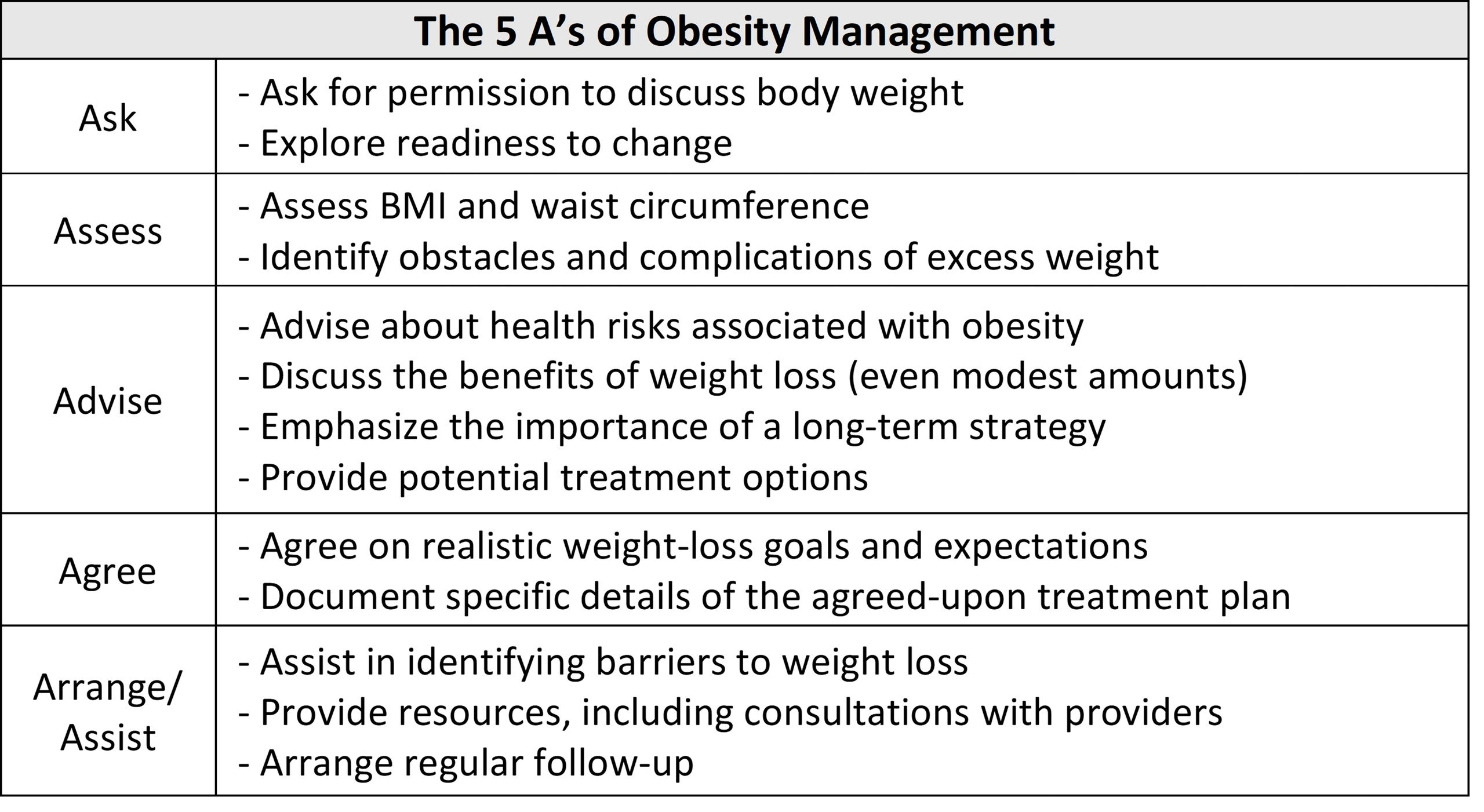
The ABOM may incorporate a number of these concepts in several questions. Besides just rote memory, you should be able to select from options of appropriate patient instructions, such as, “Which of the following statements is most appropriate at this time?” Although there are a lot of other tools that we will get to, this gives you the basic framework to understand where these questions may head. These questions feel more subjective and likely are. But if you know that your goal is to have the patient come up with the solution (or identify their barriers to change) and not just to tell them what they should do, you will be surprised at how quickly you can rule out incorrect answers.
Sample Question
A 28-year-old woman presents to discuss her prior weight loss attempts. She states she drinks four sodas a day and eats out almost daily for convenience. She says she finds it impossible to imagine not having these eating patterns. Which of the following phrases would be most appropriate at this time?
A. Why do you think you cannot change?
B. It sounds like you need some family support
C. You seem motivated to make some changes
D. Why do you drink that much soda in a day?
E. It is easier to quit these habits than you think
Next Week: Immediate RYGB complications: Anastomotic Leak.
Following Week: Monthly Knowledge Check (Subscribe!). This is a review checklist of must-know items for ABOM exams based on the previous four blog topics. In addition, this will include a brief explanation of the correct answers to previous sample questions.
For more practice questions, check out the following:
- Obesity Medicine Board Review Questions (2026): Qs 212, 223, and 243.
- Obesity Medicine Practice Tests (2026): Qs 42, 107, 110, 157, and 296.
(Copyright 2026) Obesity Medicine Board Review Questions, LLC: obesitymedicinereview.com
Featured image: Modified from VectorStock (image license purchased)
Copyediting by Kelly Smith
Now available: A full line of ABOM study resources with 775+ challenging questions in a mobile or book format. Access to both formats is available in a discounted Ultimate Package, which also includes a Pass Guarantee (if you fail the exam in 2026, you get the 2027 edition free), 50 bonus questions released in August, and the newest book, Obesity Medicine: Sample Questions and Study Blogs, which includes all the updated previous study blogs in a paperback format. Check it out here!
