

The American Association of Clinical Endocrinology Consensus Statement: Algorithm for the Evaluation and Treatment of Adults with Obesity/Adiposity-Based Chronic Disease- 2025 Update provides an algorithm for patient-centered, individualized obesity care that covers screening, diagnosing, staging, and preferred treatment options. Shortly after its release, it was added to the ABOM exam resource list. This resource will be dissected over the next two weeks. Importantly, this blog should not be used as a substitute for reading the actual guidelines. This blog is simply a highlight reel of what I felt were the most high-yield elements when studying for the exam. If treating patients with obesity or taking the ABOM exam, it is imperative to be familiar with these guidelines, which can be found here. This first blog will work through the front sections, which cover definitions, screening and assessment, staging, and clinical evaluation. Next week, we will focus on the treatment options.
Terms: ABCD vs ORCD
Adiposity-based chronic disease (ABCD) is an all-encompassing term for the underlying pathophysiology resulting from dysregulated adipose tissue, which can lead to chronic disease via neurohormonal effects (adiposopathy) and/or mass effect. This is not based on body mass index (BMI) but rather on the dysfunction that excess adipose tissue causes at the organ and even cellular levels. It includes both the underlying risk factors and any disease-related complications related to obesity. In contrast, obesity-related chronic disease (ORCD), which falls under the umbrella term ABCD, refers to specific, diagnosable conditions associated with excess adiposity, such as diabetes and sleep apnea. Although further discussed below, as a preview, the presence of ORCD helps stage patients into one of the 3 categories. For example, a patient with excess weight, even if otherwise clinically healthy (i.e., pre-clinical obesity), would still fall under the ABCD term and be staged as AACE stage 1. However, if the patient develops an ORCD such as osteoarthritis or hyperlipidemia, they would now be staged as 2 or 3 based on the severity of the ORCD.
Step 1: Screening and assessment
Screening for excess weight consists of an anthropometric component, followed by a physical exam to confirm the diagnosis. Although BMI has limitations, the AACE algorithm acknowledges and recommends its use for initial screening, combined with clinical judgment, taking into account ethnicity-specific BMI cut-offs. In addition, muscle mass (excess or sarcopenia), edema, amputations, etc., may affect the accuracy or utility of this measurement. If excess adiposity is appreciated on physical exam, ethnic-specific BMI cut-offs also help categorize the class of adiposity as overweight or class I, II, or III obesity.
In contrast to BMI, a waist circumference (WC) and waist-to-height (WH) ratio indicate the distribution of excess weight, with increased values inferring higher cardiometabolic risk. Like BMI, normal waist circumference cut-off values are lower in those of Asian descent. It is recommended to measure waist circumference in anyone with an elevated BMI up to 35 kg/m² to risk-stratify, as central adiposity (i.e., increased waist circumference) places the patient at higher cardiovascular risk. Anyone above this BMI threshold of 35 kg/m² already imposes a higher cardiovascular risk, and the addition of a WC provides little additional value. In contrast to WC, the benefit of a WH ratio is that, regardless of ethnicity or sex, a value ≥0.5 indicates a higher cardiometabolic risk. For example, if a patient is 6 feet (72 inches) tall, then a waist circumference greater than or equal to half that value, 36 inches, would indicate a higher cardiometabolic risk. This works similarly with centimeters. Another way to think about this is that the waist circumference should be less than half the height.
Body composition may also be considered, especially when there are discordant results from anthropometric measurements and clinical findings. In addition, it can be used to monitor compositional changes during weight loss, with DXA considered the gold standard due to its cost, accuracy, and availability.
Note: There are many different numbers in these guidelines, many of which include ethnicity-based cut-offs. Clinically, it would be helpful to have a reference sheet, but for the ABOM exam, I would commit the following to memory:
- Waist-to-height ratio ≥0.5 indicates a higher cardiometabolic risk across all ethnicities
- WC cutoff values of ≥102 cm (40 inches) in men and ≥88 cm (35 inches) in women are consistent with abdominal obesity for the United States and Canada.
- In most Asian populations and Latin America, the WC cutoff values are generally considered to be ≥90 cm for men and ≥80 cm for women.
- Body fat percentages >25% in men or >32% in women are consistent with excess adiposity (OMA states 30% and 35%, respectively).
- Be familiar with the World Health Organization’s BMI classifications, as shown in the table below:

- In addition, for treatment, note that BMI thresholds should be adjusted in Asian populations, with overweight defined at 23 kg/m² and obesity at 25 kg/m². This allows this population with a BMI ≥27.5 kg/m² to be offered metabolic and bariatric surgery.
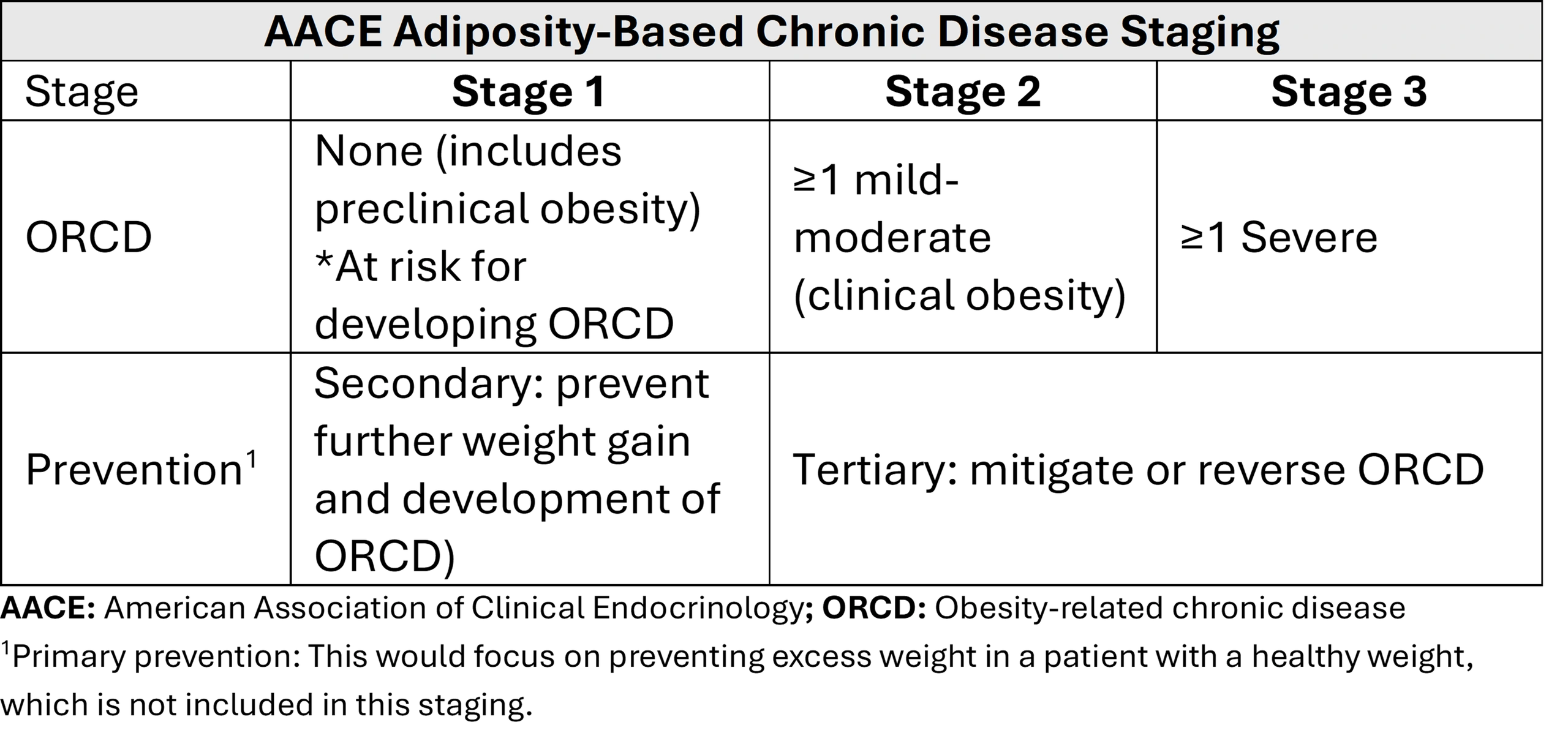
Step 2: ABCD Staging
Per the AACE guidelines, the intensity of treatment for excess weight should not be determined solely by body mass index, but rather by the clinical impact of excess weight on patients’ health. Thus, evaluation for ORCD is needed to stage. Importantly, stage 1 is considered part of ABCD, and even if no ORCD is present, treatment may still be indicated to prevent its development. The difference between stage 2 and 3 is based on ORCD severity, determined by clinical judgment depending on symptoms, level of impairment, and required treatment intensity. For example, a patient with asymptomatic coronary artery disease noted on a coronary calcium CT scan would be considered stage 2, whereas a patient with coronary stents or a history of a coronary artery bypass grafting would be stage 3. The staging profile is summarized in the table below.
Clinical workup
The clinical workup section is not intended to be a comprehensive, step-by-step guide to the evaluation and history-taking for patients with obesity, but rather a foundational framework. It emphasizes that both the initial evaluation and long-term follow-up (given that obesity is a chronic, lifelong disease) are essential components of high-quality care and should be considered the standard.
Consider the treatment of a patient presenting with a large foot wound. Effective treatment would not be to simply provide bandages and advise follow-up only when supplies run out. Instead, we would investigate the underlying cause, such as diabetes, vascular disease, or infection, and use this to treat the wound accordingly. Similarly, obesity care requires evaluation of underlying drivers, barriers, and potential complications. With the growing prevalence of online-based obesity treatment platforms, there is an increasing risk that patients may receive medications without appropriate clinical evaluation. This concern is highlighted throughout the guidelines, culminating in a clear statement that the online prescribing of medications without ongoing involvement of healthcare professionals constitutes “substandard care” and places patients at risk. This underscores the importance of a thorough clinical workup and sets the stage for individualized treatment planning, which will be discussed in the next blog.
Therefore, a comprehensive evaluation should include the following components:
- Medical/weight history
- Physical exam
- ABCD-specific review of systems
- Family/social history
- Medication review: This should include anti-obesity medications that have been trialed in the past, as well as an evaluation of whether the patient is on any weight-promoting medications.
- Laboratory evaluation for ORCD: An evaluation of cardiometabolic health includes AST/ALT and platelets to calculate Fib-4, which estimates the risk of significant fibrosis, fasting glucose and HbA1c, a lipid panel, and creatinine. Other labs can be ordered as indicated for a general health evaluation.
- Further testing: Specialized testing is not recommended for all patients, but rather should be guided by clinical history and prior evaluation. When indicated, this may include assessment for hypothyroidism (TSH), osteoarthritis (X-rays), Cushing syndrome (e.g., dexamethasone suppression testing), metabolic dysfunction–associated steatotic liver disease (MASLD; liver elastography), obstructive sleep apnea (polysomnography), and genetic conditions.
- Referrals: Specialized referrals to psychologists, behavioral therapists, dietitians, sports medicine, etc., may be considered based on individualized findings.
Lifestyle Interventions
Although we are going to get into the pharmacologic treatments in the next blog, for a comprehensive approach, regardless of treatment options, it is important to incorporate lifestyle and behavioral interventions, as well as related screening, with highlights summarized below:
- Nutrition: A sustained caloric deficit is required for weight loss, with anti-obesity medications and metabolic and bariatric surgery serving as tools to help maintain this deficit long term. Emphasis is placed on diet quality, including reducing energy-dense foods and avoiding ultra-processed foods.
- Dietary interventions: This includes an individualized dietary plan aligned with patient goals and cultural preferences, with appropriate support. Long-term adherence is the primary goal; no single macronutrient pattern is superior for weight loss, but rather, sustainability matters most. When initiating second-generation anti-obesity medications, recommend a multivitamin (including iron and calcium), consider meal replacements as needed, and ensure adequate overall nutrient intake. Adequate dietary protein is essential during weight loss to help preserve lean mass.
- Physical activity: Working toward a goal of ≥150 minutes per week of moderate-to-vigorous aerobic activity, along with 2–3 days of resistance training, provides significant health benefits but typically results in only modest weight loss (1–3%). Resistance training helps preserve lean mass, which supports energy expenditure and, in older adults, helps prevent sarcopenia. Higher activity levels (200–300 minutes per week) are associated with improved weight maintenance and reduce the risk of weight regain after weight loss.
- Sleep: Inadequate sleep quality or duration can adversely affect cardiovascular health and alter energy expenditure, promoting weight gain. Treatment of obstructive sleep apnea with CPAP improves quality of life and overall health outcomes, but studies do not show that this results in weight loss.
- Weight bias: Stigma, including internalized weight bias, negatively affects health and can interfere with motivation and the adoption of healthy habits that promote weight loss. Screening for and addressing body image dissatisfaction or disordered eating can support long-term success.
In this blog, we covered key terms, initial workup, staging, and foundational lifestyle modifications and screenings. Next week, we will review pharmacologic treatment options based on ORCD severity and AACE staging.
Sample Question
A 52-year-old man with obesity (BMI 41 kg/m²) presents for follow-up after being diagnosed with moderate-to-severe obstructive sleep apnea on polysomnography. He reports loud snoring, daytime fatigue, and frequent nighttime awakenings. He is started on continuous positive airway pressure (CPAP) therapy. At a 3-month follow-up visit, he asks what benefits he should expect from continued CPAP use, particularly regarding his weight and overall health. Which of the following statements regarding CPAP therapy in obstructive sleep apnea is most accurate?
A. It leads to weight reduction
B. It improves quality of life
C. It directly decreases visceral adiposity
D. It increases basal metabolic rate, promoting weight loss
Next Week: AACE Algorithm for Evaluation and Treatment of Obesity (2025) Part 2
Upcoming: Monthly Knowledge Check. This is a review checklist of must-know items for ABOM exams based on the previous four blog topics. In addition, this will include a brief explanation of the correct answers to previous sample questions.
For more practice questions, check out the following:
- Obesity Medicine Board Review Questions (2026)
- Obesity Medicine Practice Tests (2026)
(Copyright 2026) Obesity Medicine Board Review Questions, LLC: obesitymedicinereview.com
Featured image: Modified from VectorStock (image license purchased)
Copyediting by Kelly Smith
