

Proopiomelanocortin (POMC) deficiency is a relatively recently defined condition, first described in 1998. It is also very rare, affecting fewer than 500 individuals worldwide. However, clinical rarity does not equate to rarity on the ABOM exam. In this blog, we will review the characteristic findings, underlying pathophysiology, and available treatment options.
POMC deficiency is caused by pathogenic mutations or variants in the POMC gene, which is expressed in first-order neurons in the arcuate nucleus of the hypothalamus and is part of the anorexigenic pathway. This pathway is responsible for increasing energy expenditure and reducing appetite. The POMC gene encodes proopiomelanocortin, a precursor protein that is cleaved into multiple peptide products. To understand the clinical manifestations of POMC deficiency, let’s look at the cleavage products of the POMC protein:
- Adrenocorticotropic hormone (ACTH): This hormone is derived from POMC and stimulates the adrenal glands to secrete cortisol. With insufficient ACTH, adrenal crisis can occur, and is often the earliest clinical sign, presenting in neonates.
- Alpha-melanocyte-stimulating hormone (α-MSH): When POMC neurons are activated, it releases α-MSH, which activates second-order neurons as an agonist at MC3 and MC4 receptors. In POMC deficiency, α-MSH is reduced, impairing activation of downstream second-order neurons and receptors and decreasing signaling in the anorexigenic pathway, leading to hyperphagia and weight gain. Although α-MSH primarily regulates appetite and metabolism in the hypothalamus, it also stimulates melanocytes in the skin via melanocortin-1 receptors, promoting melanin production and pigmentation. Deficiency results in decreased pigmentation, often presenting as pale skin and red hair.
- B-endorphins: Like α-MSH, β-endorphin is released with POMC activation and is decreased in this condition. However, it provides inhibitory feedback to the POMC neuron, reducing activity of the anorexigenic pathway. Thus, this effect is minimal in POMC deficiency, as the POMC neuron is not adequately activated and the lack of inhibitory feedback is not a significant factor.
Clinically, neonates are often born at a normal weight but gain weight rapidly, with universal excess adiposity by age 1 due to insatiable hunger. As discussed above, adrenal crisis is often one of the first clues to this condition. Although the diagnosis is suspected clinically, it is confirmed with genetic testing to identify variants in the POMC gene.
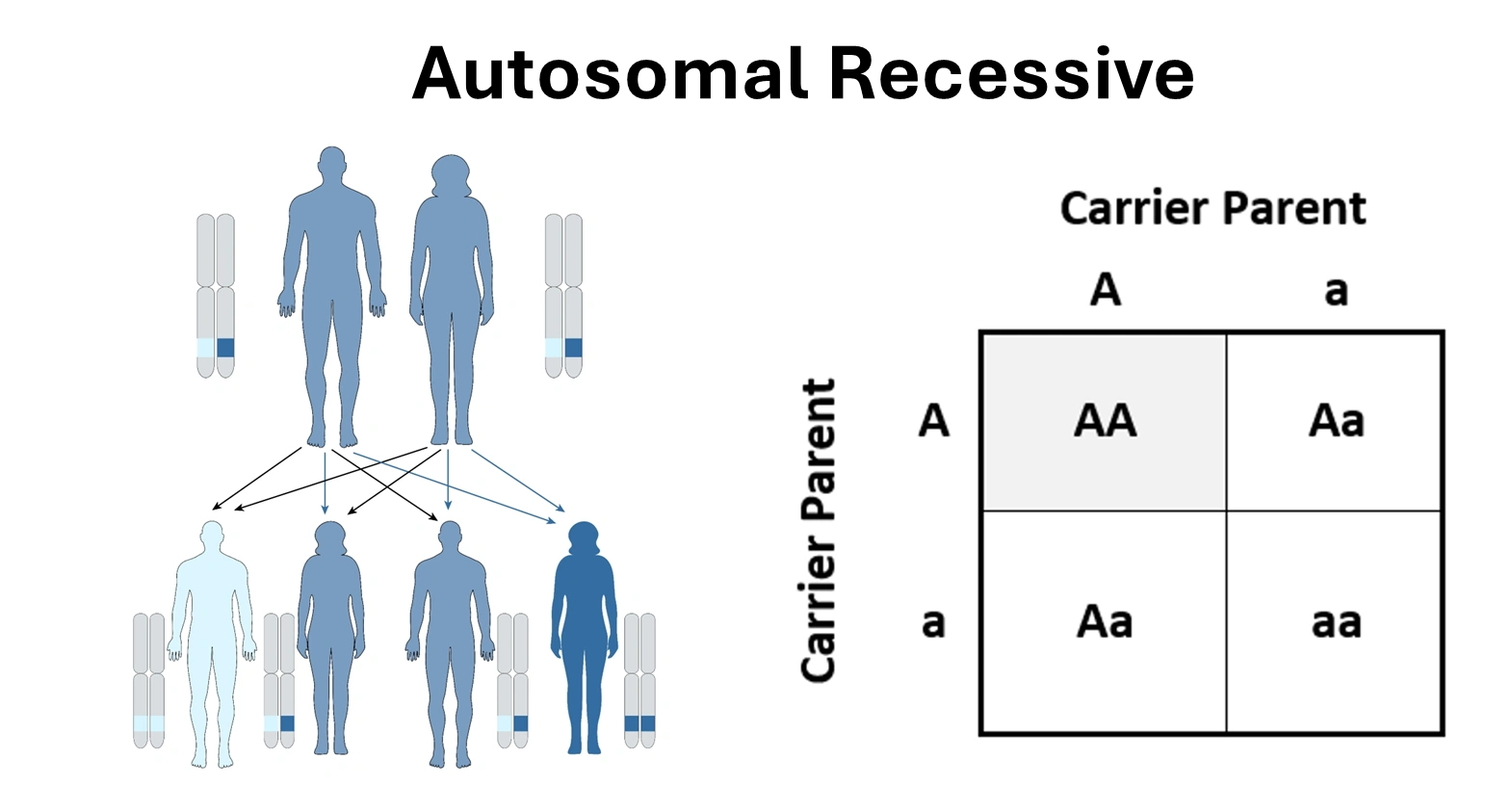
POMC deficiency is inherited in an autosomal recessive pattern. Therefore, if only one parent carries the gene mutation (AA), the offspring will be carriers (Aa). If both parents are carriers (Aa), there is a 25% risk of having an affected offspring, a 50% chance of being a carrier, and a 25% chance that the child is unaffected, as shown below. The prevalence is similar regardless of the child’s sex.
Fortunately, this is one genetic condition with an FDA-approved treatment option. Setmelanotide is a pharmacologic treatment option for individuals ≥2 years of age with POMC deficiency. This medication is an MC4R agonist and activates the downstream receptor independently, bypassing the deficient POMC pathway. Patients, on average, lose 23.1% of their body weight at one year with setmelanotide. In addition to setmelanotide, patients require hydrocortisone to manage adrenal insufficiency.
This topic is high-yield, and you should be familiar with the information presented in this blog. Know the pathophysiology, clinical manifestations, physical exam findings, treatment options, and inheritance patterns. Although encountering a patient with this condition is rare, its characteristic findings make it a prime topic for the exam.
Sample Question:
A couple submits buccal swab samples for genetic testing through a commercial company that screens for various gene mutations. Both results indicate that they are carriers of POMC deficiency. If they conceive, what is the likelihood that each child will be affected by POMC deficiency?
A. 0%
B. 25%
C. 50%
D. 100%
E. Varies depending on the sex of the child
Next Week: Built Environment
Upcoming: Tirzepatide Studies/Trials and Monthly Knowledge Check
For more practice questions, check out the following:
- Obesity Medicine Board Review Questions (2026): Qs 2 and 30.
- Obesity Medicine Practice Tests (2026): Qs 17, 175, and 329.
(Copyright 2026) Obesity Medicine Board Review Questions, LLC: obesitymedicinereview.com
Featured image: Modified from VectorStock (image license purchased)
Copyediting by Kelly Smith
Now available: A full line of ABOM study resources with 775+ challenging questions in a mobile or book format. Access to both formats is available in a discounted Ultimate Package, which also includes a Pass Guarantee (if you fail the exam in 2026, you get the 2027 edition free), 50 bonus questions released in August, and the newest book, Obesity Medicine: Sample Questions and Study Blogs, which includes all the updated previous study blogs in a paperback format. Check it out here!
