
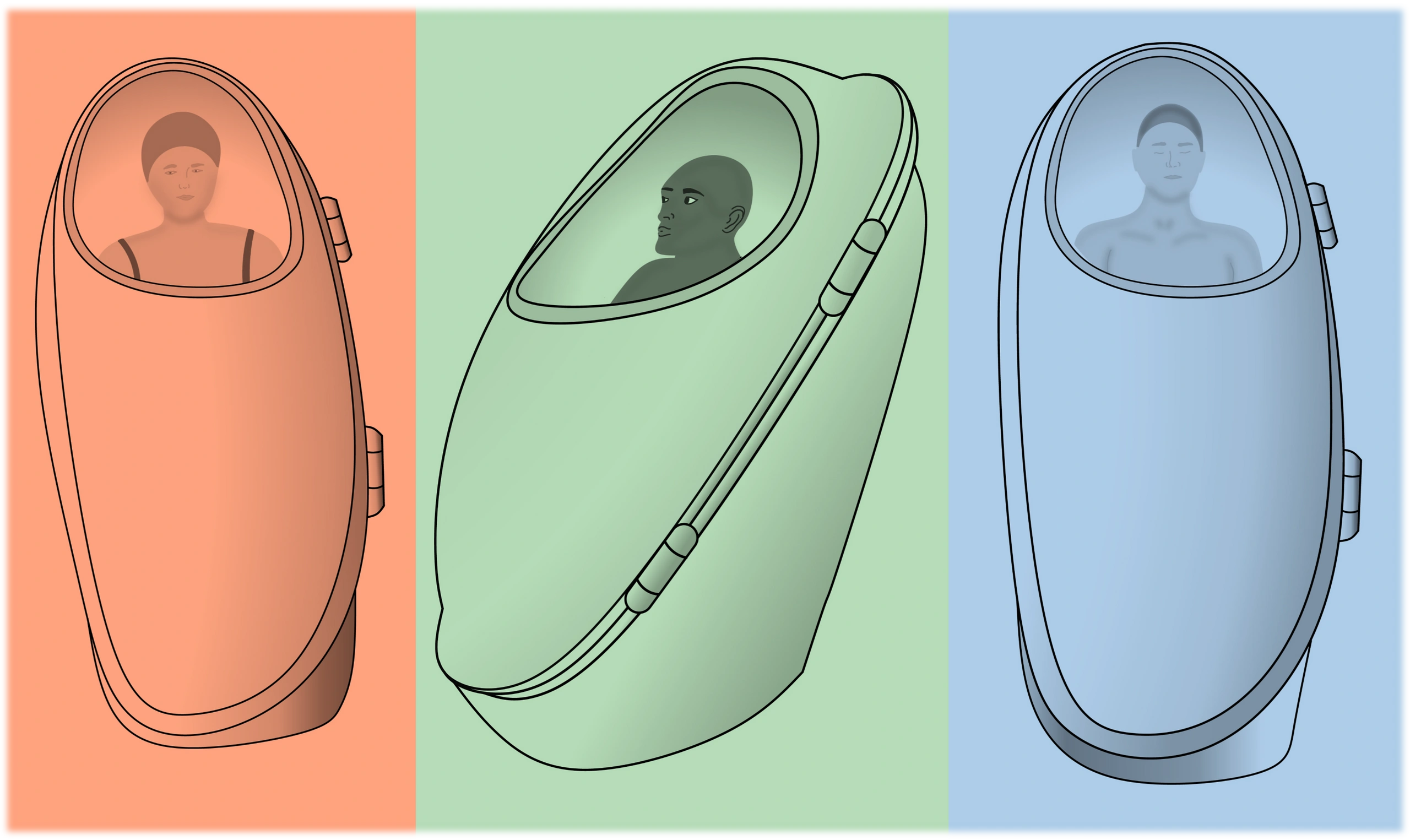
Although dual-energy X-ray absorptiometry is considered the gold standard for body composition assessment, air displacement plethysmography (ADP) is an accurate alternative for two-compartment analysis (fat mass and fat-free mass). Developed in 1994, this egg-shaped device provides data with accuracy comparable to underwater weighing, but without the associated inconvenience. In this blog, we will review how ADP generates its measurements, along with its key characteristics, advantages, and limitations.
APD calculates body composition in a nearly identical manner to underwater weighing, which is discussed further here, except that instead of using water displacement to determine volume, air is the medium displaced. Like water weighing, the patient should wear minimal clothing, or tight-fitting clothing, to improve accuracy. The patient sits in the enclosed device, where the seat acts as an integrated scale to measure body mass. Then, different volumes of air are added to the chamber and the pressure changes are noted. Based on the inverse relationship between pressure and volume, the device can determine body volume from these measurements, using the empty 500-liter chamber as a baseline reference. Density can then be determined using the formula, density = mass/volume.
Unlike underwater weighing, the patient is not required to fully exhale during measurement, which can be challenging, particularly in individuals with obstructive lung disease and increased residual volume. Instead, the patient breathes normally during the approximately 2-minute measurement period, and the device estimates an average lung volume. Thoracic gas volume can also be measured directly using a breathing apparatus within the chamber to further improve accuracy.
One of the major advantages of ADP over other body composition methods is its ability to accommodate a wide range of body sizes and characteristics. It can be used in individuals as young as 2 years of age and accommodates those up to 550 lb (250 kg) and 7 feet tall. In contrast, modalities such as DXA and MRI have table weight limits that may restrict use in individuals with higher body weight. ADP is also efficient, typically requiring less than 5 minutes to complete a measurement. Additionally, it does not involve radiation exposure, and the per-use cost is relatively low, with machines costing approximately $30,000–$40,000, and a typical test costing the patient $50–$100 per scan. These advantages have led the manufacturer to describe the device as a “practical gold standard” for body composition assessment.
So, what are the downsides? Although the device includes a viewing window, individuals with significant claustrophobia may still have difficulty tolerating the enclosed chamber. In addition, while it is approved for use in children as young as 2 years of age, keeping a toddler still inside the device, even for a short period, could be challenging. Finally, ADP provides only a two-compartment model of body composition, fat mass and fat-free mass. While fat-free mass generally approximates lean mass within about 5% and can be used to track changes over time, ADP cannot directly measure specific components such as skeletal muscle mass. In contrast, modalities such as DXA or bioelectrical impedance can provide more detailed compartmental analysis.
Understanding body composition is an important content area on the ABOM exam. Be familiar with this accurate two-compartment method, including when it is preferred over other modalities, its limitations, and the basic principles underlying its use.
Sample Question:
Researchers are designing a study to compare two-compartment body composition methods and must choose between underwater weighing and air displacement plethysmography (ADP) for a diverse group of participants. They aim to select the most appropriate method for each individual based on clinical characteristics. Which of the following participants would be best suited for ADP rather than underwater weighing?
A. A 25-year-old competitive swimmer
B. A 40-year-old man with moderate COPD
C. A 32-year-old woman with class II obesity
D. A 28-year-old man with a history of anxiety
Next Week: AACE Algorithm for Evaluation and Treatment of Obesity (2025) Part 1
Upcoming: AACE Algorithm for Evaluation and Treatment of Obesity (2025) Part 2, and Medullary Thyroid Carcinoma
For more practice questions, check out the following:
- Obesity Medicine Board Review Questions (2026): Q 81, 157, and 163.
- Obesity Medicine Practice Tests (2026): Qs 77, 164, and 421.
(Copyright 2026) Obesity Medicine Board Review Questions, LLC: obesitymedicinereview.com
Featured image: Image (modified) created by Sameer M. Copyright owned by Kevin Smith, DO
Copyediting by Kelly Smith
Now available: A full line of ABOM study resources with 775+ challenging questions in a mobile or book format. Access to both formats is available in a discounted Ultimate Package, which also includes a Pass Guarantee (if you fail the exam in 2026, you get the 2027 edition free), 50 bonus questions released in August, and the newest book, Obesity Medicine: Sample Questions and Study Blogs, which includes all the updated previous study blogs in a paperback format. Check it out here!
