

Convenience and accuracy are both essential when selecting a method for routine body composition assessment. While underwater weighing (also known as hydrostatic weighing or hydrodensitometry) boasts a high level of accuracy, it lacks practicality, making it a less commonly used tool in clinical settings. In this blog, we’ll review how the test is performed, what affects its accuracy, and its key limitations.
Underwater weighing was once considered the gold standard for body fat measurement prior to the development of more advanced and convenient techniques like the DXA scan. It operates on a two-compartment model, estimating both body fat and fat-free mass by applying Archimedes’ principle. This principle states that an object submerged in water experiences a buoyant force equal to the weight of the displaced water. In other words, the more water an object pushes aside, the more upward force it experiences, and that force is equal to the weight of the displaced water. This allows the tester to estimate body volume, which is essential for calculating body density and ultimately body fat percentage.
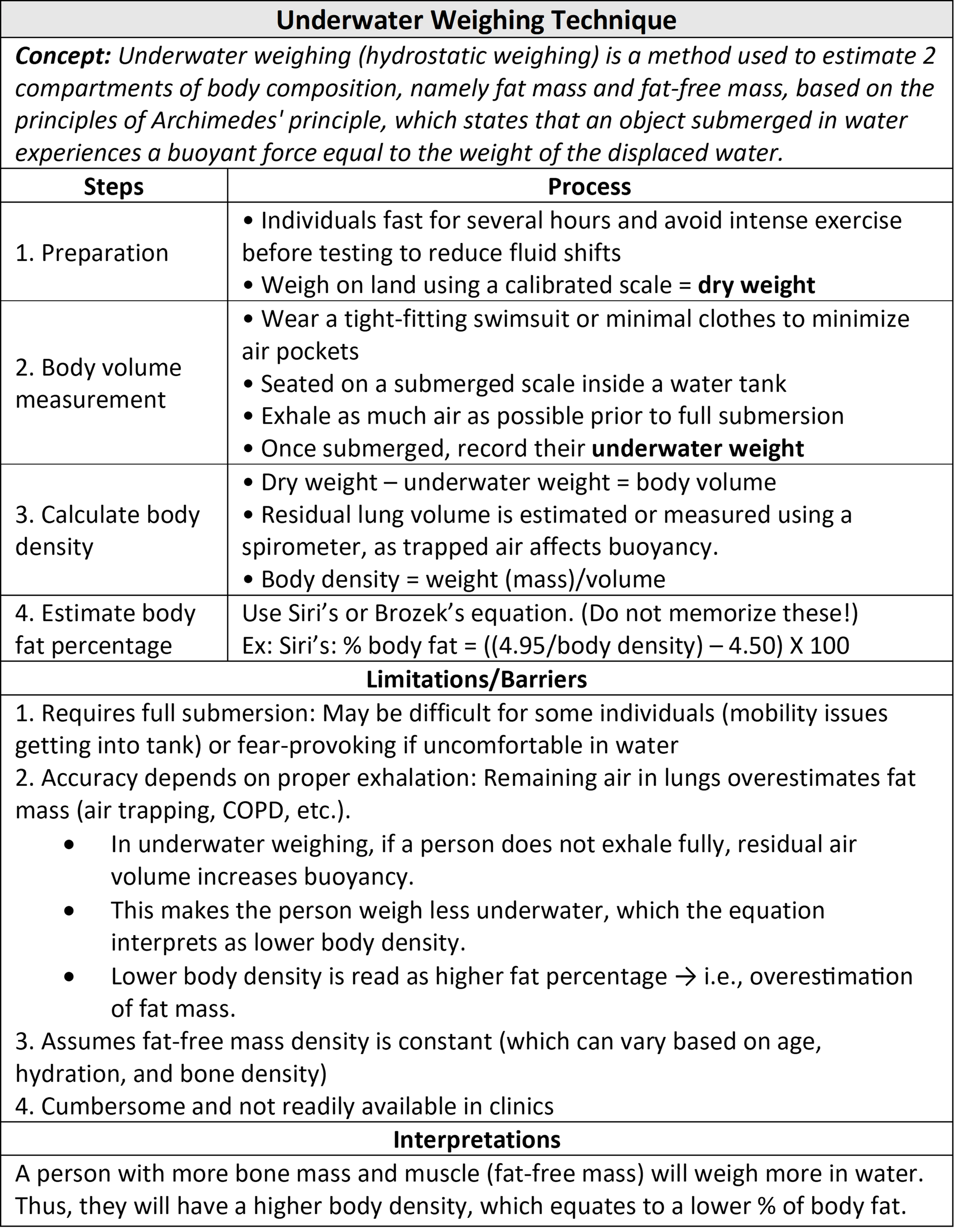
In simple terms, underwater weighing requires two key measurements: the individual’s dry weight, or body weight measured on land, and their underwater weight, obtained while they are fully submerged. With these two values, body volume can be calculated, and the actual size of the water tank becomes irrelevant to the computation. Below is a list of the steps in order to obtain the relevant values.
Preparation: The individual should fast for several hours and avoid intense exercise before testing to reduce fluid shifts, similar to the preparation for bioelectrical impedance analysis (BIA). Minimal clothing (e.g., tight-fitting swimsuit) should be worn to limit excess weight and avoid trapping air, which could increase buoyancy.
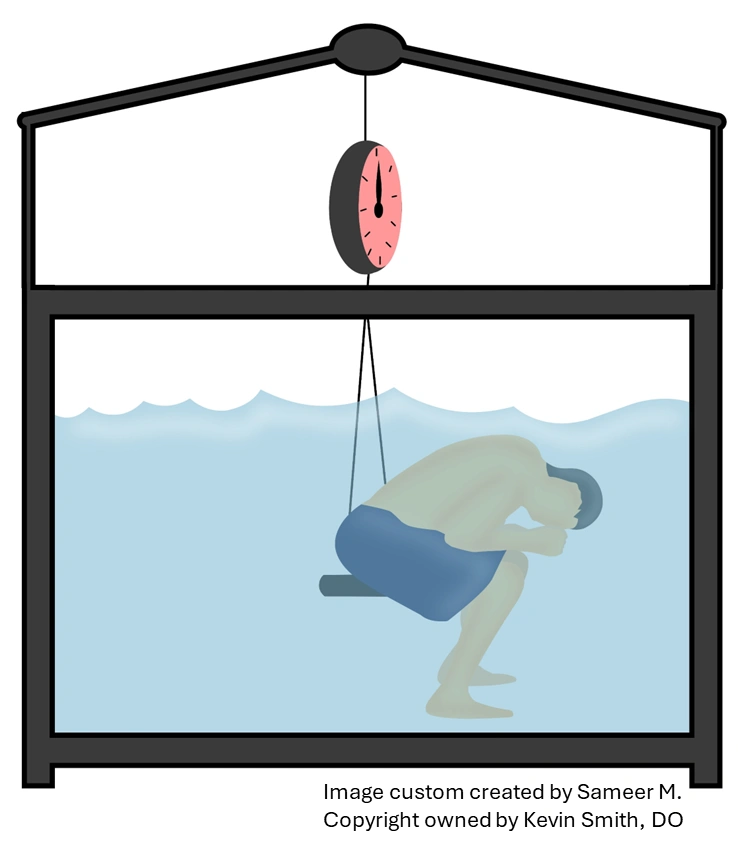
Procedure: After obtaining the dry weight on a calibrated scale, the individual is seated on a scale-connected platform submerged in water, as shown in the image. They are then lowered until fully underwater and instructed to exhale as much air as possible before the underwater weight is recorded. Since residual lung volume (the air that remains in the lungs after exhalation) affects buoyancy, it can be estimated or measured directly using spirometry for greater accuracy.
Calculations and interpretation:
- Body volume is determined by subtracting the underwater weight from the dry weight.
- Body density is then calculated by dividing mass (weight) by volume.
- Body fat percentage is estimated using formulas like the Siri or Brozek equations. Neither of these needs to be memorized for the ABOM exam, but as an example, the Siri equation for determining body fat % is: Body fat % = ((4.95 / body density) – 4.50) × 100
Fat-free mass, which is primarily composed of muscle and bone, is denser and therefore weighs more when submerged in water. A greater underwater weight reflects a higher body density. According to the Siri equation, body density is inversely proportional to body fat percentage. Therefore, individuals with greater muscle mass and higher body density will have a lower calculated body fat percentage, while those with lower muscle mass will have a higher body fat percentage.
Although the calculations involved in underwater weighing are relatively straightforward, the logistical challenges make it impractical for routine use. Access to a water tank or pool, the need for patients to change clothes and become fully submerged, and the physical setup requirements make this method considerably more cumbersome than an in-office BIA or referring a patient for a DXA scan. In other words, you’re unlikely to see hydrostatic weighing companies promoting their equipment at obesity conferences as convenient “in-office” body composition revenue tools. Additionally, individuals with mobility limitations or discomfort in water are poor candidates for this testing method.
Beyond inconvenience, there are also accuracy limitations. Without the use of spirometry, the test assumes that the patient can exhale fully and achieve universal minimal residual lung volumes. However, individuals with air trapping, such as those with COPD, retain more air in their lungs, which increases buoyancy. This leads to an underestimation of underwater weight, a lower calculated body density, and ultimately a higher estimated body fat percentage. Similarly, individuals with osteoporosis may have reduced bone density affecting the assumption that fat-free mass density is constant. In other words, variations in age, hydration status, or bone mass can introduce systematic errors in body fat estimates using this method.
As we know, board examinations often test foundational concepts regardless of the current popularity or availability of the tools involved. Underwater weighing provides an excellent framework for understanding two-compartment body composition analysis and how various factors can skew results, either underestimating or overestimating body fat. While it may not be widely used in everyday obesity medicine practice, it remains a high-yield topic that should be clearly understood for the ABOM exam.
Sample Question
A health club is using underwater weighing (hydrostatic weighing) to assess body composition in various patients. Which of the following individuals is most likely to have an overestimation of body fat percentage using this method?
A. A 65-year-old man with severe chronic obstructive pulmonary disease
B. A 45-year-old competitive weightlifter with high muscle mass and low body fat
C. A 70-year-old woman with osteopenia on calcium and vitamin D supplementation
D. A 50-year-old man with high fluid retention due to chronic kidney disease
E. A 30-year-old endurance runner with a very low resting heart rate
Next Week: Brown/Beige adiposity
Following Week: Monthly Knowledge Check. This is a review checklist of must-know items for ABOM exams based on the previous four blog topics (VLCD, antibiotics and ACE, underwater weighing, and brown/beige adiposity). In addition, this will include a brief explanation of the correct answers to previous sample questions.
Upcoming: ASN (nephrology) guidelines, functional foods, preoperative evaluation, pediatric challenges (bullying, stigma, and food insecurity)
For more practice questions, check out the following:
- Obesity Medicine Board Review Questions (2026): Q 163.
- Obesity Medicine Practice Tests (2026)
(Copyright 2026) Obesity Medicine Board Review Questions, LLC: obesitymedicinereview.com
Featured image: Modified from VectorStock (image license purchased)
Copyediting by Kelly Smith
Now available: A full line of ABOM study resources with 775+ challenging questions in a mobile or book format. Access to both formats is available in a discounted Ultimate Package, which also includes a Pass Guarantee (if you fail the exam in 2026, you get the 2027 edition free), 50 bonus questions released in August, and the newest book, Obesity Medicine: Sample Questions and Study Blogs, which includes all the updated previous study blogs in a paperback format. Check it out here!
