

The American Medical Association (AMA) recently recommended looking for alternative ways to evaluate a patient’s health beyond relying on BMI alone. Even before the AMA made this recommendation, it has been well known that BMI does not always tell the entire story. Alternative methods of measuring body composition can provide a more accurate measurement of adipose tissue and lean muscle, which ultimately can help tailor alternative sustainable health and weight loss goals for our patients.
The following are the most common methods for testing body composition, along with their limitations and accuracy:
- Skinfold calipers: This is the simplest and cheapest method to determine body fat percentage. Calipers are used to measure the thickness of skinfolds at strategic places on the body, assuming that 50% of fat lies directly below the skin (subcutaneous fat). Once these measurements are made, you would utilize a chart to convert this into a body fat percentage. This measurement is user-dependent and is significantly less accurate in those with high levels of adiposity.
- Bioelectrical impedance analysis (BIA): This inexpensive device measures the rate at which small electrical signals pass through the body. Adipose tissue has increased resistance compared to lean mass and thus takes longer to pass through the body. The time it takes for current to transmit through the body, as the patient is holding metal conductors and/or standing barefoot on electrodes, can be measured to provide body composition. Patients should be euvolemic at the time of the scan. Overhydrated patients may see a decrease in body fat, while dehydration overestimates fat. In addition, patients with any electrical cardiac device (pacemaker, defibrillator, etc.) should avoid this form of measurement due to the theoretical risk of interference.
- Dual-energy X-ray absorptiometry (DXA): Many of the same devices that evaluate bone density, depending on the software and machine, can be utilized to evaluate body composition. Some of the more advanced DXA scanners are able to differentiate between visceral and subcutaneous fat. This is considered the gold standard for board exams, as it is relatively cheap for patients, safe (although it does expose the patient to small amounts of radiation), and very accurate.
- Air displacement plethysmography (i.e., BOD POD™): This has largely replaced underwater densitometry and uses air instead of water to determine the volume of a patient. Patients sit in an enclosed egg-shaped looking machine, which measures the occupied volume of air displaced by a person in the machine. This is used to determine the patient’s density (density = mass/volume), ultimately allowing for the determination of body fat and lean body mass.
- CT/MRI: These imaging devices are expensive but accurate. Patients are exposed to radiation with the CT scan, and both may be limited options in those with very high BMIs given table limitations, similar to the DXA scan. In addition, MRI spectrometry should also be avoided in those with cardiac devices.
- Isotope dilution hydrometry: This is used only in research and is considered the most accurate testing of body fat composition at the molecular level. It utilizes a water isotope tracer which is taken up by all cells in the body except body fat, allowing for the calculation of non-fat mass.
So, what can we do with these measurements? Oftentimes, our patients will begin an exercise regimen at the same time as pursuing weight loss. As they build lean mass, the BMI or weight may not change as much as they expect. However, evaluating a change in body composition through one of the above devices, demonstrating decreased adiposity, can be a rewarding metric.
These measurements can also help diagnose someone with obesity in the presence of a relatively normal body mass index. This is especially important in the elderly, who often lose muscle mass and replace it with fatty tissue while maintaining a stable weight/BMI. This is called sarcopenic obesity, a condition that could easily be missed if focusing strictly on the weight or body mass index. Interestingly, a CT scan is considered the gold standard to diagnose sarcopenia, although functional studies are more commonly performed (e.g., hand grip strength, etc.).
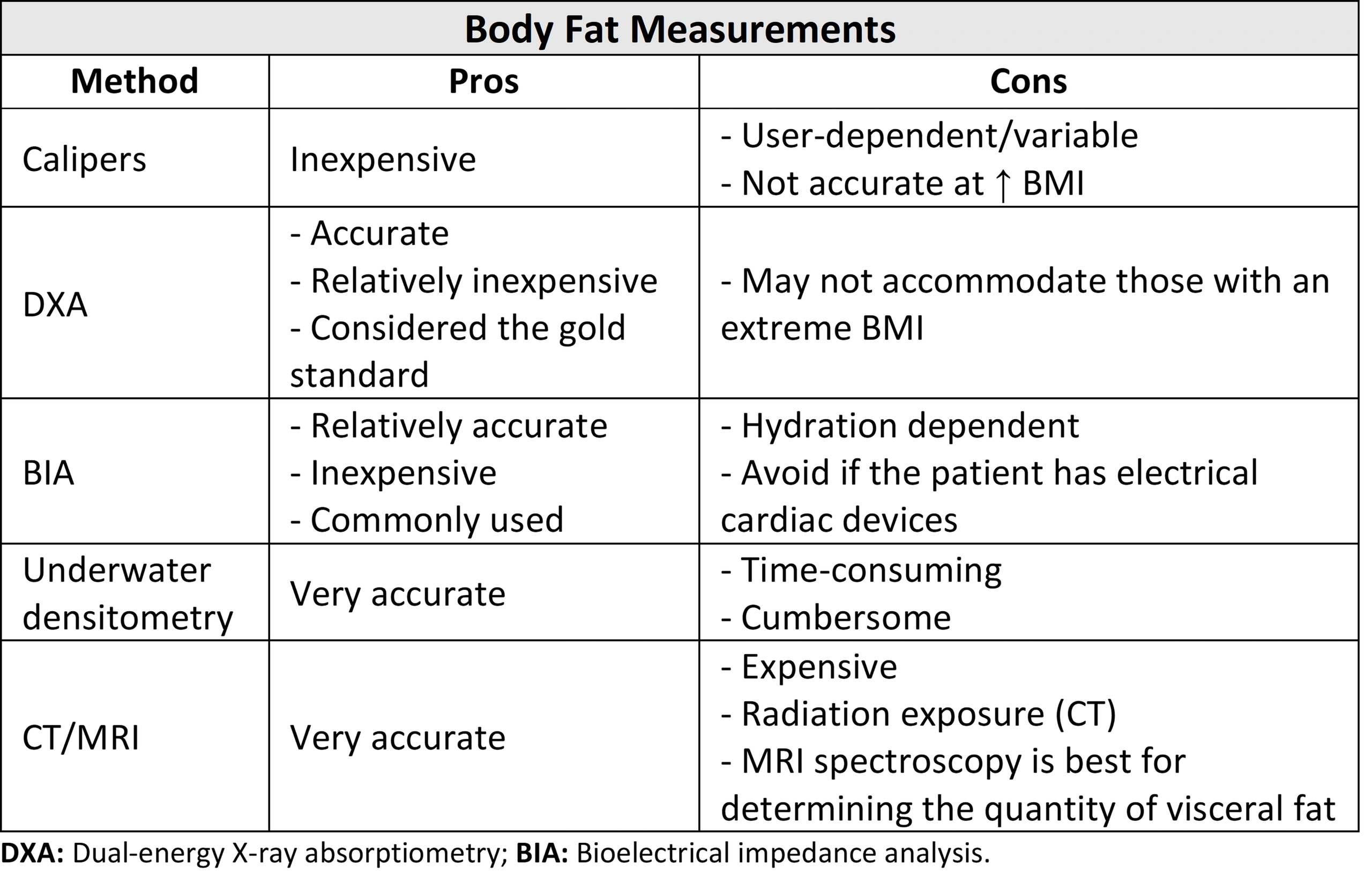
On exam day, the ABOM will want you to determine which body fat composition tool is the most appropriate for the given patient. This includes understanding each of the methods’ limitations. The table below is a quick summary of the highlights from the methods discussed previously.
Sample Question
For a small cost, a kiosk at the mall measures body fat percentages via bioelectrical impedance analysis (BIA) or calipers. Which of the following patients should BIA be recommended for testing instead of calipers?
A. BMI > 45 kg/m²
B. Presence of a cardiac pacemaker
C. Patient with decompensated cirrhosis
D. Patient with poor skin turgor
Next Week: Pradar-Willi vs. Angelman.
Upcoming: Monthly Knowledge Check. This is a review checklist of must-know items for ABOM exams based on the previous four blog topics (Meal-terminating anorexigenic hormones, Aspire Assist® device, body fat measurements (calipers vs. DXA, etc.), and Pradar-Willi vs. Angelman). In addition, this will include a brief explanation of the correct answers to previous sample questions.
For more practice questions, check out the following:
- Obesity Medicine Board Review Questions (2026): Qs 4, 31, 81, and 157.
- Obesity Medicine Practice Tests (2026): Qs 12, 77, 164, 292, and 421.
(Copyright 2026) Obesity Medicine Board Review Questions, LLC: obesitymedicinereview.com
Featured Image: Modified from VectorStock (image license purchased)
Copyediting by Kelly Smith
Now available: A full line of ABOM study resources with 775+ challenging questions in a mobile or book format. Access to both formats is available in a discounted Ultimate Package, which also includes a Pass Guarantee (if you fail the exam in 2026, you get the 2027 edition free), 50 bonus questions released in August, and the newest book, Obesity Medicine: Sample Questions and Study Blogs, which includes all the updated previous study blogs in a paperback format. Check it out here!
