
It’s always enjoyable to write (and read) blogs on fun topics, like tirzepatide or new procedures, but not so much on basic foundational topics. So, let’s rip the band-aid off and cover a basic ABOM topic: energy expenditure.
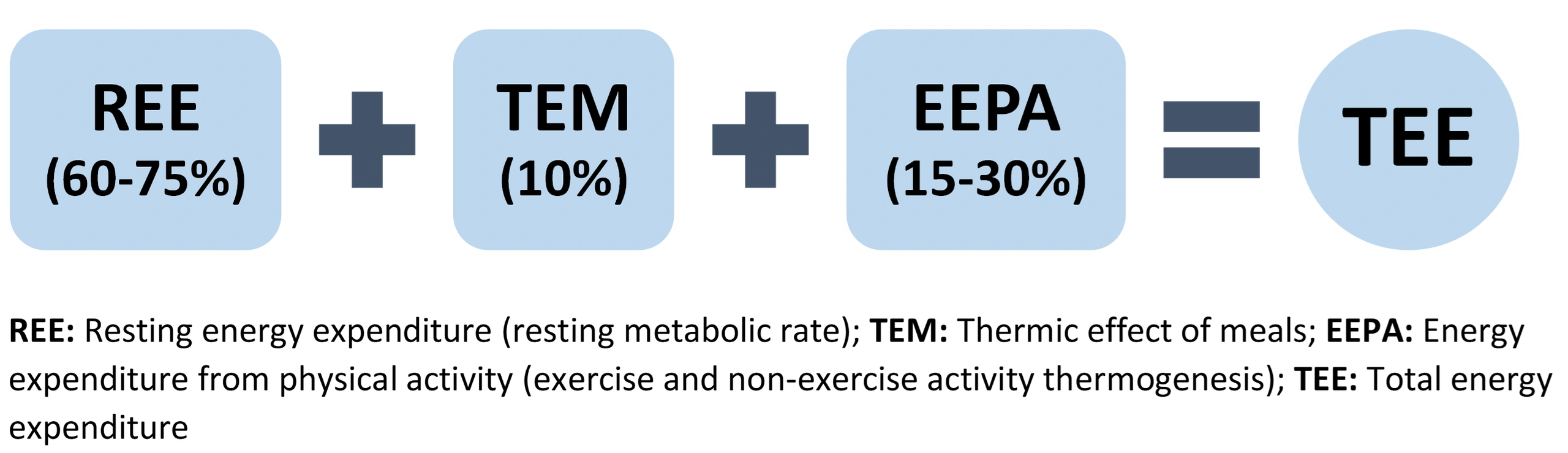
Fortunately, there is not much to memorize; nonetheless, the concepts are essential. Let’s start with total energy expenditure. This is the total energy used during a unit of time, most commonly a day. It consists of three areas:
- Resting energy expenditure (REE): These are the calories consumed at the basal (i.e., sedentary) rate. If you were to sit all day (supine) without moving a single extremity, you would have REE. Essentially, this is the minimum calories needed to survive. Often an indirect calorimeter or formulas are used to estimate this value.
- Thermic effect of meals (TEM): This refers to the energy required to acquire calories from food. This includes the energy consumed during absorption, metabolism, and storage of calories.
- Energy expenditure from physical activity (EEPA): All activities, whether pacing the room or taping your foot (non-exercise activity thermogenesis, also known as NEAT) or those from dedicated exercise, will require calories to perform. This is considered EEPA.
So why does this matter? Well, some patients have lower basal metabolic rates (REE). This is classically the patient who doesn’t eat much throughout the day and still cannot lose weight. So, if we can increase this, for example, by increasing muscle mass or via medications such as phentermine, this could increase basal metabolic rate, caloric expenditure, and caloric deficit. Similarly, changing dietary habits (increasing fiber or chewing food 20 times before swallowing can affect TEM), or modifying physical activity (EEPA), then the total energy expenditure increases. At the same caloric intake, you would expect a caloric deficit.
Each of these components leads to total energy expenditure (TEE). Commit those percentages to memory, as they may give you three of the four components and expect you to determine the missing link.
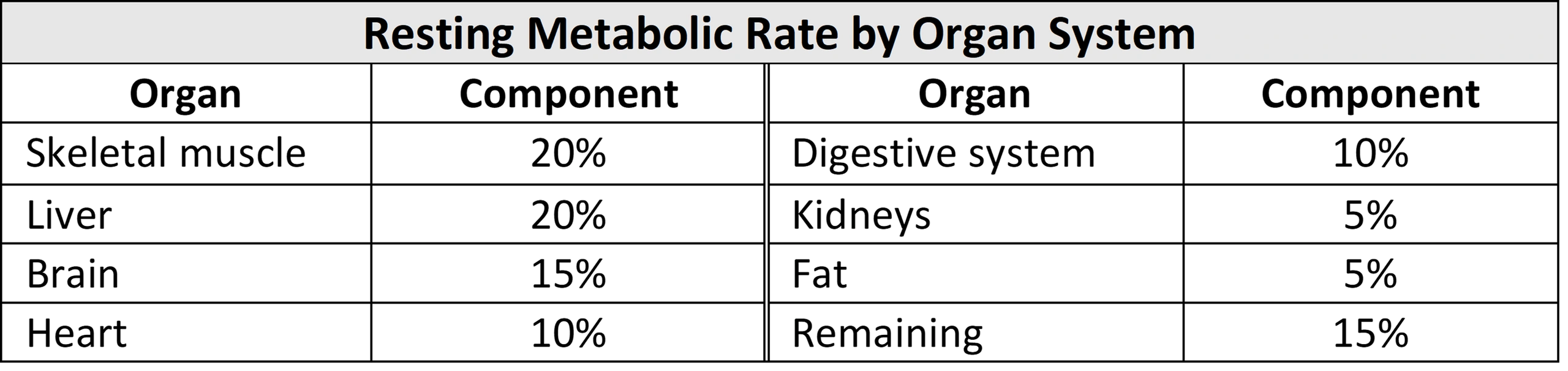
Finally, understand that different organs consume different amounts of calories at rest. This makes sense as you would expect that the large skeletal muscles consume more calories than the stationary fat. Although specific percentages are lower yield, understand which organs consume a more significant portion of calories compared to the more metabolically inactive organs, as summarized in the table below.
Sample Question:
A 31-year-old woman wants to know her total energy expenditure. She estimates her non-exercise activity thermogenesis to be 800 kcal/day, her thermic effect of meals to be 10% of her total expenditure, and her calories from exercise 400 kcal/day. What other testing is necessary to determine her total energy expenditure accurately?
A. Indirect calorimeter
B. Skinfold calipers
C. Duke’s treadmill score
D. Bioelectric impedance analyses
E. Basal body temperature
Next Week: Sleeve Gastrectomy
Upcoming Weeks: Dietary changes and their effect on the lipid panel plus a monthly Knowledge Check.
For more practice questions, check out the following:
- Obesity Medicine Board Review Questions (2026): Qs 4, 32, 37, 124, and 139.
- Obesity Medicine Practice Tests (2026): Qs 41, 59, 108, 121, 171, and 336.
(Copyright 2026) Obesity Medicine Board Review Questions, LLC: obesitymedicinereview.com
Featured image: Modified from VectorStock (image license purchased)
Copyediting by Kelly Smith
Now available: A full line of ABOM study resources with 775+ challenging questions in a mobile or book format. Access to both formats is available in a discounted Ultimate Package, which also includes a Pass Guarantee (if you fail the exam in 2026, you get the 2027 edition free), 50 bonus questions released in August, and the newest book, Obesity Medicine: Sample Questions and Study Blogs, which includes all the updated previous study blogs in a paperback format. Check it out here!
