

Food insecurity represents a major stressor and health-complicating factor for many within the United States. Recent research from the USDA shows that in 2023, 13.5%, or 18 million households, within the United States experienced food insecurity within that year. Similarly to how adverse childhood experiences (ACEs) can cause such dysregulation that leads to long-lasting effects on health, there is a strong correlation between food insecurity and health outcomes affecting children and adults. Today’s blog will give you an overview of the health concerns and what to keep in mind come test day.
Food insecurity is defined as inconsistent or uncertain access to safe, nutritious foods or difficulty obtaining adequate food through normal, socially acceptable means. This insecurity is not always represented by going hungry. Many live within communities where there is an overabundance of calorie-dense, nutrient-poor food readily available, known as a “food swamp,” and can simultaneously have limited access to regular grocery stores, known as a “food desert” creating a barrier for families to consume more nutritious foods.
Those at the highest risk of food insecurity experience poverty. USDA research shows that those with a household income-to-poverty ratio under 1.85 face the highest prevalence of food insecurity. Other common characteristics are households with children, single-parent homes (particularly those headed by women), adults living alone, and those living in the southern region of the U.S. While all ethnicities can experience food insecurity, Black and Hispanic individuals face higher rates. The chart below compares the prevalence between states.
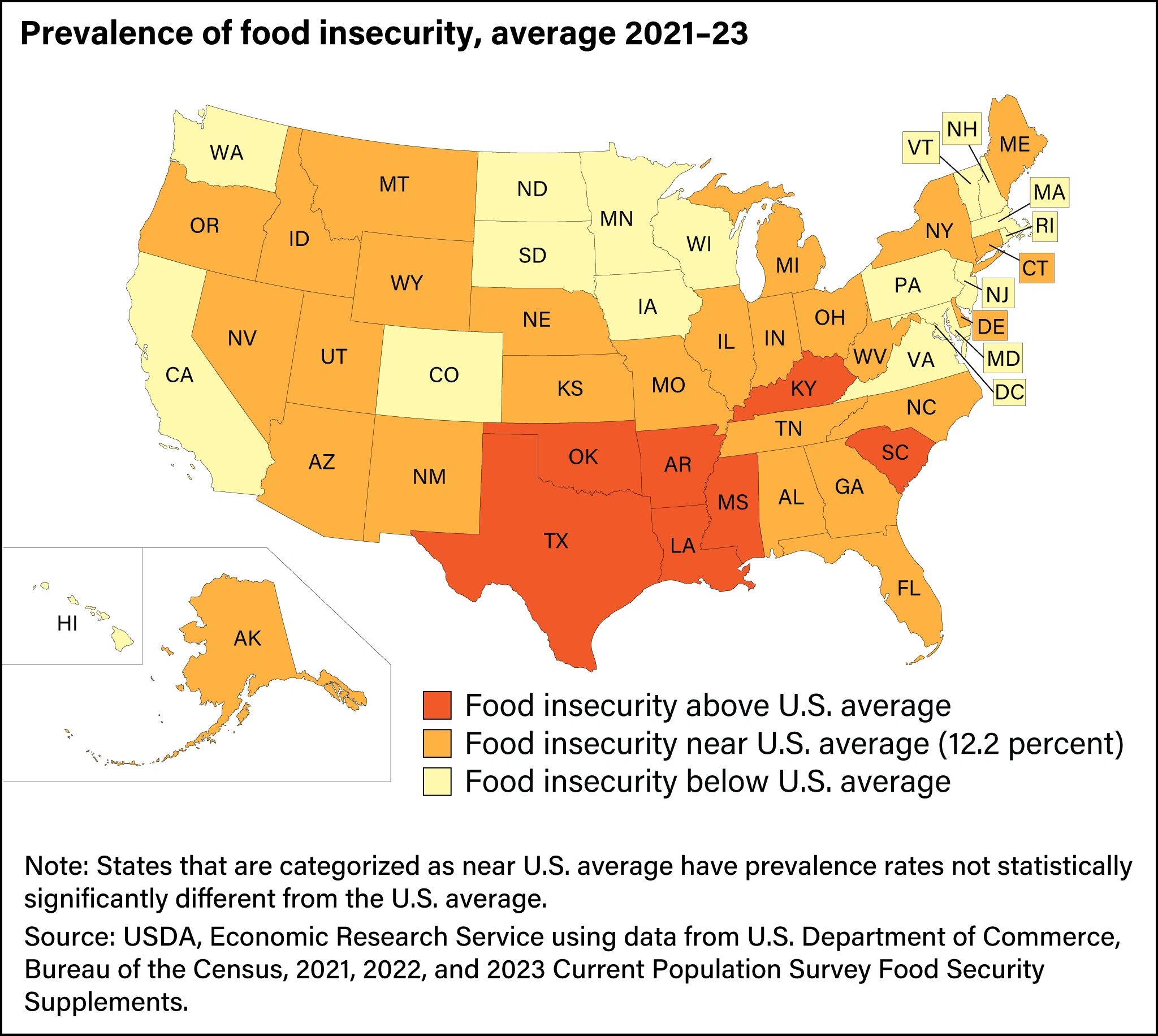
The impact of food insecurity can be lifelong and long-lasting, particularly for children. Cycles of food deprivation and overeating, coupled with greater exposure to marketing of energy-dense food, contribute to higher levels of stress and anxiety. As referenced above from a previous blog post in June, ACEs can adversely affect children’s health. Chronic levels of stress can lead to obesity, depression, cardiovascular disease, alcohol use disorder, and even cancer. Identifying patients at risk for food insecurity will be key.
Screenings for food and nutrition insecurity can be accomplished by using a validated two-question tool, called the Hunger Vital Sign™, which is appropriate for use in adolescents and adults. This can be asked during intake and incorporated into other screening questionnaires:
- “Within the past 12 months, we worried whether our food would run out before we got money to buy more.”
- “Within the past 12 months the food we bought just didn’t last and we didn’t have money to get more.”
If one or both questions are answered positively, then the screening indicates that the individual is at risk for food insecurity. A positive screening should then prompt further discussion to determine and address immediate food needs, such as emergency food or referrals to local food distribution. On subsequent visits, health care providers can monitor ongoing food and nutrition needs and make referrals to community and government programs.
As for the ABOM exam, you should have a well-rounded understanding of the relationship between socioeconomic determinants of health and obesity. Understand that regardless of age, what the role of chronic stress and weight change plays. Lastly, be able to identify environmental/ geographic characteristics that can impact food access and how to screen for them appropriately
Blog written by Kelly Smith, BSN
Sample Question
A 12-year-old boy presents for a routine well-child visit. His mother reports that because she is a single working parent, the children often prepare their own meals. She notes that while there are several convenience stores and gas stations within walking distance, access to grocery stores is limited. She frequently worries that food at home may not last until the next paycheck, though the family manages to “get by.” The patient has three siblings with similar eating patterns. Which of the following best explains how this patient’s current living environment may influence his eating habits?
A. Families in food swamps often eat less calories due to the increased cost of convenience foods
B. Food insecurity protects against weight gain by reducing access to food
C. Families with food insecurity have a reduced risk of type 2 diabetes in adulthood
D. Food insecurity leads to preferential consumption of inexpensive, calorie-dense foods
Next Week: Microbiome and SIBO
Following Week: Women and Obesity
Upcoming: Knowledge Check
Blog Citations
1. USDA. Food Security in the U.S. – Key Statistics & Graphics. https://www.ers.usda.gov/topics/food-nutrition-assistance/food-security-in-the-us/key-statistics-graphics. Accessed 8-30-25
2. Expert Panel. (1990). Core indications of nutritional state for difficult-to-sample populations. Journal of Nutrition, 120(11, Suppl.), 1559-1600.
3. Hartline-Graftons, H. (2015). Understanding the connections; Food insecurity and obesity.
4. Hager, E. R., Quigg, A. M., Black, M. M., Coleman, S. M., Heeren, T., Rose-Jacobs, R., Cook, J. T., Ettinger de Cuba, S. A., Casey, P. H., Chilton, M., Cutts, D. B., Meyers A. F., Frank, D. A. (2010). Development and Validity of a 2-Item Screen to Identify Families at Risk for Food Insecurity. Pediatrics, 126(1), 26-32. doi:10.1542/peds.2009-3146.
For more practice questions, check out the following:
- Obesity Medicine Board Review Questions (2026): Q 120.
- Obesity Medicine Practice Tests (2026)
(Copyright 2026) Obesity Medicine Board Review Questions, LLC: obesitymedicinereview.com
Featured image: Modified from VectorStock (image license purchased)
Copyediting by Kelly Smith
Now available: A full line of ABOM study resources with 775+ challenging questions in a mobile or book format. Access to both formats is available in a discounted Ultimate Package, which also includes a Pass Guarantee (if you fail the exam in 2026, you get the 2027 edition free), 50 bonus questions released in August, and the newest book, Obesity Medicine: Sample Questions and Study Blogs, which includes all the updated previous study blogs in a paperback format. Check it out here!
