

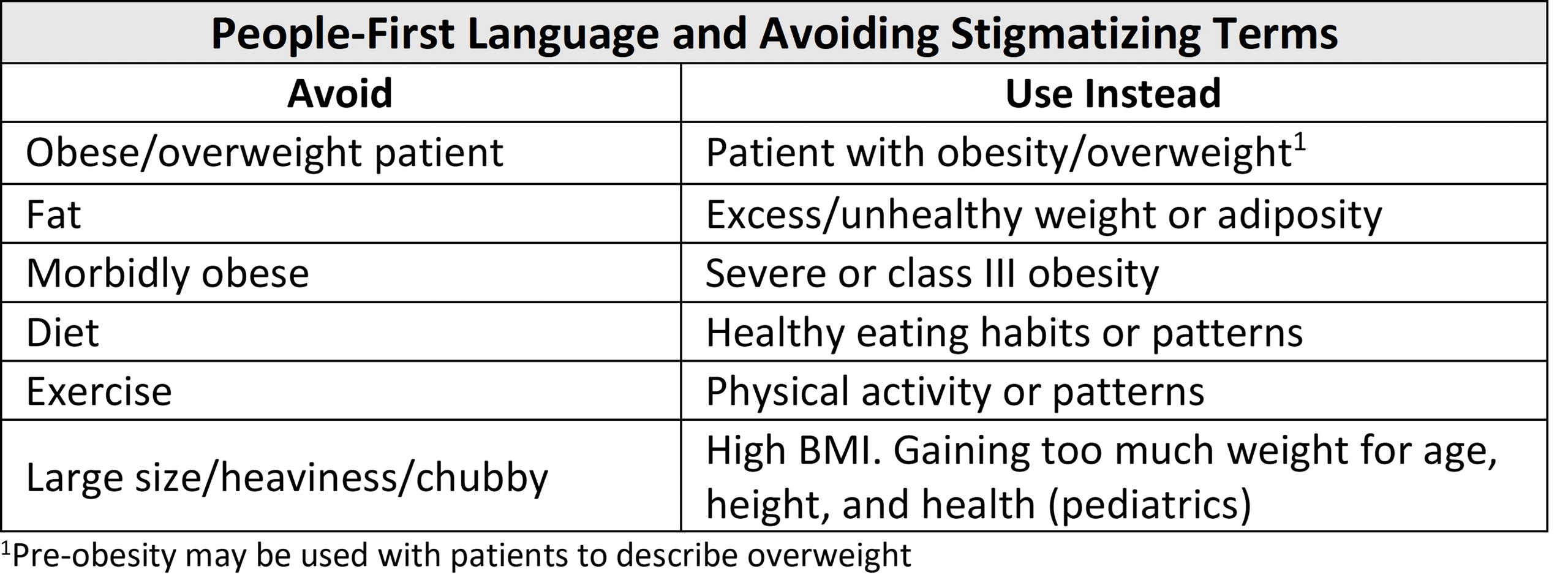
A person may have a disease and is affected by it, but their value is greater than their condition. People-first language recognizes this importance and works to separate the value of the individual from their disease. Within obesity medicine, this type of language helps to promote positive provider-patient relationships and decreases biases or stigmas by not defining patients by their chronic disease of obesity.
However, people-first language can be incorporated in all areas of practice, as it replaces assumptions or stereotypes with more positively associated terms. Some examples are provided below:
- “An obese man presents to the clinic” becomes, “A man with obesity.”
- “A diabetic patient” becomes “a patient with diabetes.”
- “A female schizophrenic” becomes “a patient affected by schizophrenia.”
A quick rule of thumb is to avoid using conditions ending in ‘ic’ when describing the patient (i.e., alcoholic, schizophrenic, diabetic, etc.). In addition, there is very little reason to use the adjective ‘obese.’ Obesity medicine journals are moving away from publishing articles using the word obese and opting for people-first language instead. Although this may take some practice getting into the habit of changing your phrasing, it will benefit your patient relationships. As with many developed habits, it will become more natural, and you will easily notice when you hear non-people-first language.
In addition to people-first language, another similar ABOM test content item is on stigma and bias within the healthcare system. In other words, how do we reduce our patients’ anxiety about coming in for evaluation and treatment?
One of the initial impressions a patient will experience is the waiting room. Consider the type of furniture and reading materials provided in a waiting room. Often, chairs are not adequately sized, and there is a lack of obesity-sensitive reading materials available, which can cause discomfort and potential embarrassment. Magazines with very thin, photoshopped models promoting non-evidence-based fad diets should be removed. Additionally, all staff should be trained in using appropriate first-person language that is free from bias, stigma, shaming, and embarrassment. Other necessary preparations include:
- Furniture to accommodate >300 lb
- Wide chairs with handrails or standard chairs without side rails
- Exam tables with a capacity of up to 600 lb
- Blood pressure cuffs and gowns in large and extra-large sizes
- Scales that are capable of weighing patients up to 350 lb-700 lb (calibrated monthly and located in a private area)
Essentially, you want to be prepared, accommodating, and encouraging to minimize shame and embarrassment for any patient seeking evaluation and treatment. Person-first language makes this a fluent and natural process.
Sample Question
A 27-year-old man with a body mass index of 34 kg/m² presents to his primary care physician for a follow-up from an emergency department visit for intractable nausea that has since resolved. He is very disappointed with his experience, as he requested hospital records and found that the emergency room notes included wording that he felt was hurtful and counterproductive. Which of the following statements would be an appropriate opening identifying statement regarding his weight?
A. A 27-year-old morbidly obese man
B. A 27-year-old individual affected by obesity
C. A 27-year-old obese patient
D. A 27-year-old man with class II obesity
Bonus (November 2nd): I took the Exam…. NOW WHAT?? Carolynn Francavilla, MD, FOMA, ABOM
Next Week: Monthly Knowledge Check (Subscribe!). This is a review checklist of must-know items for ABOM exams based on the previous four blog topics (Micronutrient deficiencies, night-eating syndrome, NPY/AgRP vs. POMC/CART, and people-first language). In addition, this will include a brief explanation of the correct answers to previous sample questions.
A short break: Writing this blog has been a highlight this year, and I am so appreciative of you, for taking the time to read and provide feedback. With ABOM testing season coming up, followed by the holidays, I will be taking a break from posting to the blog. I will kick off the next season of blog posts in early spring. Best of luck to all of you taking boards in November! Please reach out after the test about any topics not covered in the book, so it can be updated accordingly.
For more practice questions, check out the following:
- Obesity Medicine Board Review Questions (2026): Qs 323 and 327.
- Obesity Medicine Practice Tests (2026): Q 408.
(Copyright 2026) Obesity Medicine Board Review Questions, LLC: obesitymedicinereview.com
Featured image: Modified from VectorStock (image license purchased)
Copyediting by Kelly Smith
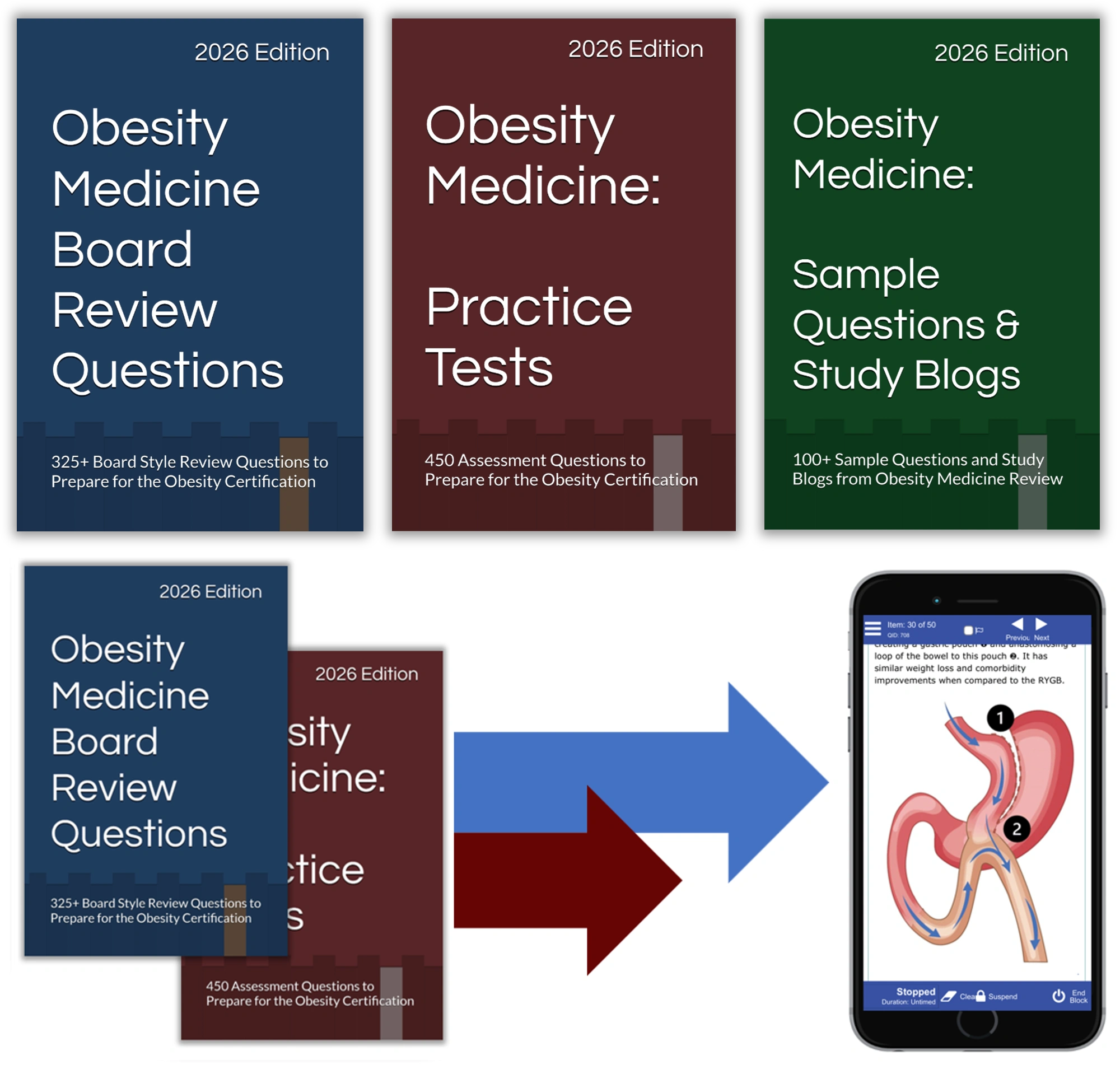
Now available: A full line of ABOM study resources with 775+ challenging questions in a mobile or book format. Access to both formats is available in a discounted Ultimate Package, which also includes a Pass Guarantee (if you fail the exam in 2026, you get the 2027 edition free), 50 bonus questions released in August, and the newest book, Obesity Medicine: Sample Questions and Study Blogs, which includes all the updated previous study blogs in a paperback format. Check it out here!
