
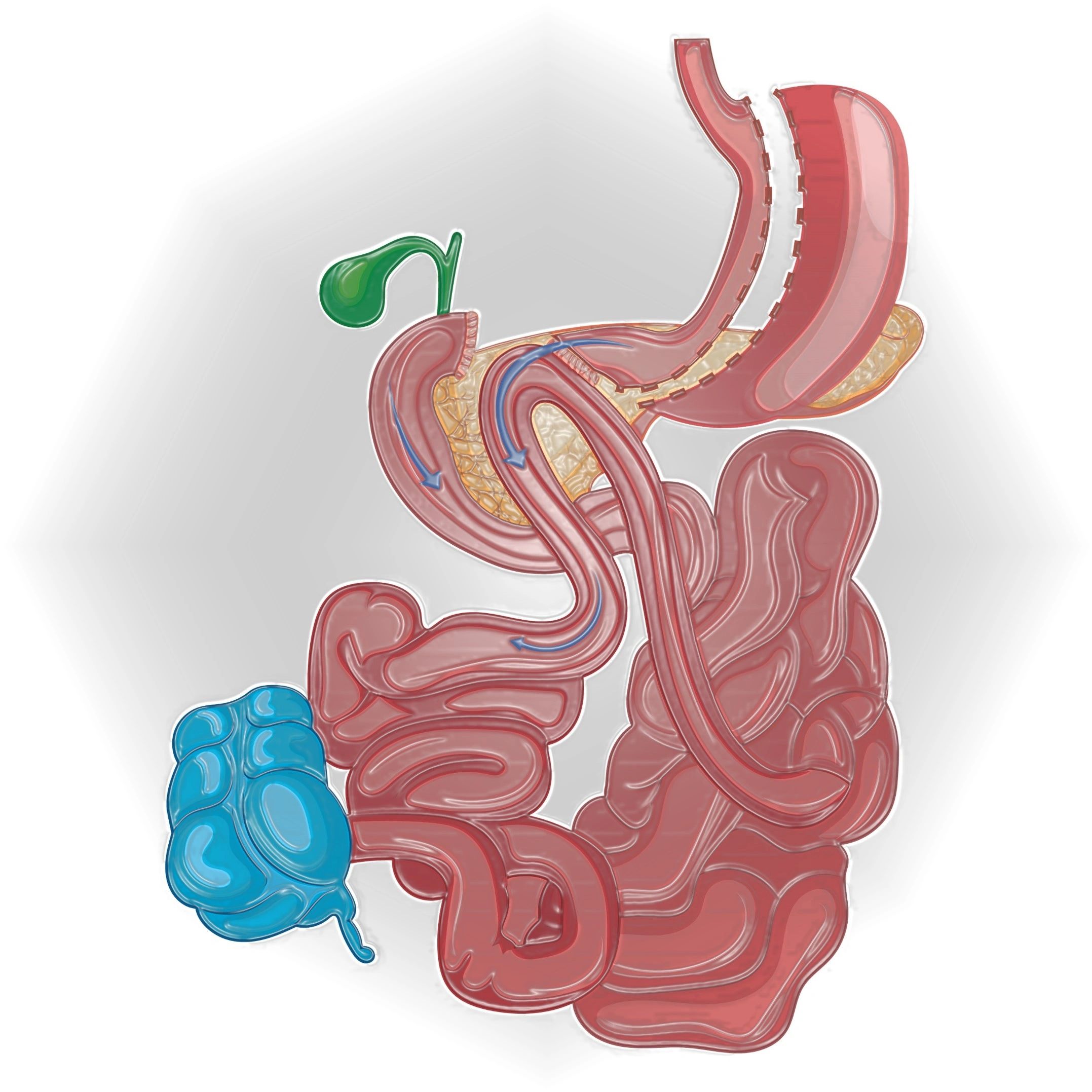
How well do you know your malabsorptive procedures? Although the ABOM exam will likely not require in-depth knowledge of surgical procedures, you will need a general understanding of the types of procedures, indications, risks, complications, effectiveness, and contraindications. This week I want to take a closer look at the single anastomosis duodeno-ileostomy with sleeve gastrectomy (SADI-S), also referred to as a stomach intestinal pylorus sparing surgery (SIPSS).
The diagram below shows a simplified example of what is done during the SADIS and the duodenal switch. During the SADI-S, a sleeve gastrectomy ❶ is performed, providing a restrictive and hormonal (decreased ghrelin) mechanism. It also involves stapling and cutting the duodenum ❷ just distal to the pylorus (pylorus remains intact) and anastomosing a loop of the intestine to the stomach ❸. This procedure has fewer complications than the duodenal switch, including less malabsorption and only one anastomosis. It has increased weight loss and diabetes remission when compared to the Roux-en-Y gastric bypass.
In a duodenal switch, a sleeve gastrectomy is also performed ❶. The intestine just distal to the stomach is cut and stapled ❸ and a portion of the small intestine is brought up and creates an anastomosis with the stomach ❷. The portion of the intestine that contains the digestive enzymes is connected to the alimentary tract, thus making a common channel ❹ that eventually drains into the large intestines.
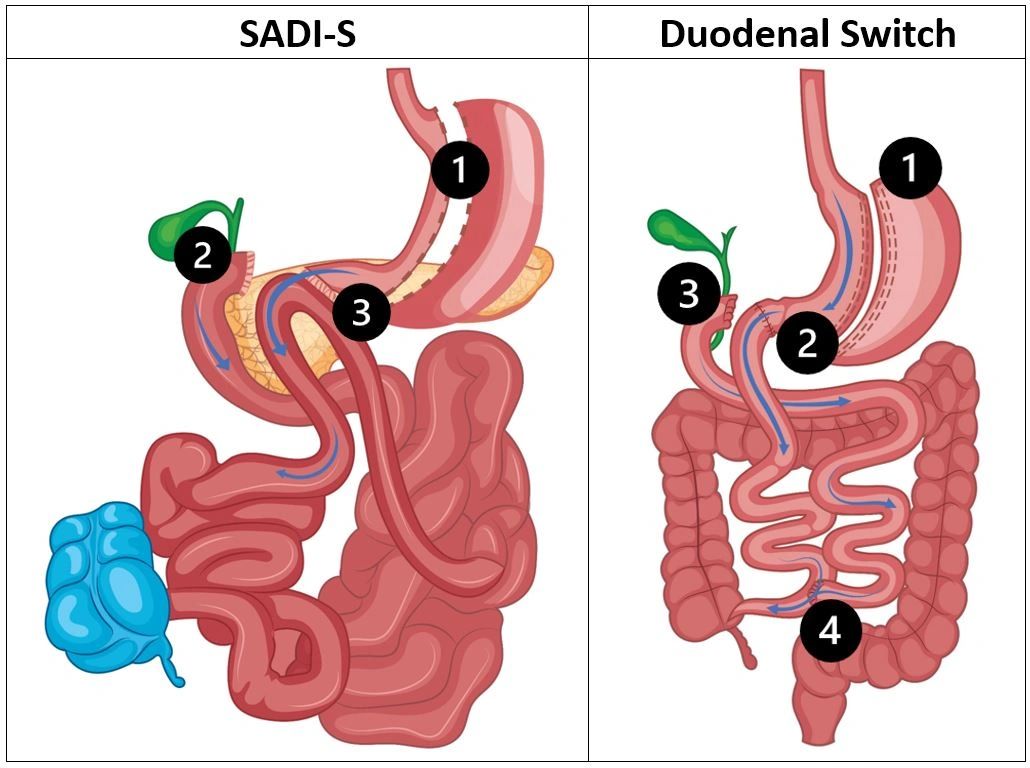
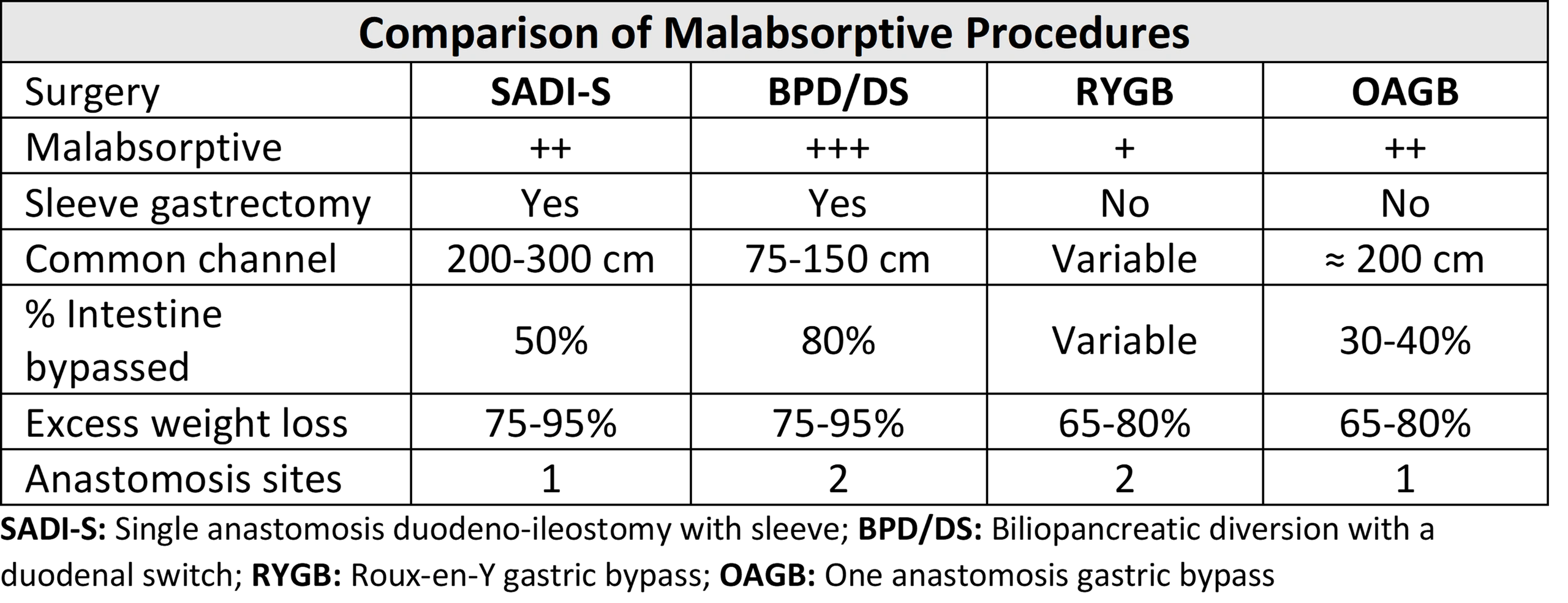
Both procedures involve performing a concurrent sleeve gastrectomy, significantly reducing ghrelin levels, as this orexigenic hormone is produced in the gastric fundus. This is an added benefit when compared with a Roux-en-Y gastric bypass (RYGB). However, it can also be a relative contraindication in those with significant GERD, as a gastric sleeve can worsen reflux symptoms. Additionally, Barrett’s esophagus and a hiatal hernia would be contraindications to the sleeve portion. In all three procedures (RYGB, SADI-S, or duodenal switch), GLP-1 levels increase significantly post-operatively due to the intestinal release of this hormone when the carbohydrate-rich nutrients avoid initial breakdown in the duodenum. This can put diabetes into remission immediately after surgery.
A SADI-S may be preferred over RYGB in patients with a BMI >50 kg/m². Malabsorptive procedures such as the SADI-S and duodenal switch provide 15% more weight loss than a RYGB and higher resolution of diabetes. Compared to the duodenal switch, the SADI-S has fewer anastomotic sites, less malabsorption, and fewer overall complications, thus increasing its popularity. Like the duodenal switch, the SADI-S can be used as a revision of a prior surgery or as a second stage in high-surgical-risk patients.
Many of the complications that occur with a SADI-S or duodenal switch also occur in the setting of a RYGB. Instead of rehashing those here, I have provided the titles below to previous blogs covering these topics:
- Anastomotic Stricture and Ulcers
- Anastomotic Leaks
- Micronutrient Deficiencies
- Vitamin B Deficiencies
Importantly, boards will require knowledge of nutritional deficiency symptoms, which is common in the setting of malabsorptive procedures. Of the three, the duodenal switch has the most significant malabsorption, which predominantly has to do with the percentage of small intestines bypassed. Up to 80% of the intestines are bypassed in a duodenal switch, leaving a short common channel (the distance of intestines after the digestive tract, which carries digestive enzymes, and the alimentary tract, which carries the food, connect). If a patient presents after a duodenal switch with an odd symptom, look for nutritional deficiencies.
Lastly, I want to mention the updated surgery indications. In 2022, the American Society for Metabolic and Bariatric Surgery (ASMBS) and the International Federation for the Surgery of Obesity and Metabolic Disorders (IFSO) updated metabolic and bariatric surgery (MBS) criteria, which include the following key changes:
- MBS is recommended for patients with a BMI ≥35 kg/m², regardless of comorbidities.
- MBS should be considered for individuals with metabolic disease with a BMI of 30-34.9 kg/m². A trial of nonsurgical management is recommended prior to pursuing surgical options in this population.
- BMI thresholds should be adjusted in the Asian population, allowing those with a BMI ≥27.5 kg/m² to be offered MBS.
- Appropriate children and adolescents should be considered for MBS
These changes are based on numerous studies showing the long-term improvement of mortality and obesity-related morbidities.
Sample Question
A 37-year-old man presents to discuss metabolic and bariatric surgical options. He had a friend who underwent a single anastomosis duodeno-ileostomy with sleeve gastrectomy (SADI-S) and has done well. He is considering the benefits and risks of this procedure in comparison to a Roux-en-Y gastric bypass (RYGB). What is the best advice to provide?
A. The SADI-S has more anastomotic sites than the RYGB
B. The SADI-S reduces ghrelin significantly more than RYGB
C. A RYGB requires more frequent monitoring of vitamin levels
D. The RYGB leads to increased remission rates of diabetes mellitus
E. The SADI-S is done through an open abdominal procedure
Review: The ABOM exam and getting started in obesity medicine: A Zoom webinar and Q&A by Carolynn Francavilla Brown, MD, D-ABOM, FOMA, and Kevin Smith, DO, D-ABOM, FACP. Watch now.
Next Week: Childhood growth chart patterns
Upcoming: Obtaining appropriate blood pressure and waist circumference measurements and Monthly Knowledge Check.
For more practice questions, check out the following:
- Obesity Medicine Board Review Questions (2026): Qs 221 and 239.
- Obesity Medicine Practice Tests (2026): Q 223.
(Copyright 2026) Obesity Medicine Board Review Questions, LLC: obesitymedicinereview.com
SADI-S and Duodenal Switch: Images created by Charu G. Copyright owned by Kevin Smith, DO
Copyediting by Kelly Smith
Now available: A full line of ABOM study resources with 775+ challenging questions in a mobile or book format. Access to both formats is available in a discounted Ultimate Package, which also includes a Pass Guarantee (if you fail the exam in 2026, you get the 2027 edition free), 50 bonus questions released in August, and the newest book, Obesity Medicine: Sample Questions and Study Blogs, which includes all the updated previous study blogs in a paperback format. Check it out here!
