
For those of you practicing pediatric or family medicine, you are probably well-versed on the diagnoses of obesity-related leg pathology in children. For the rest of us, such as myself as an internist, this will be a quick refresher on a topic we have likely not thought about since medical school. This is important because the ABOM exam is not exclusive to adult-specific questions.
Although 65% of the ABOM exam is related to general obesity topics, approximately 15% of the exam questions are pediatric and adolescent specific. One of these pediatric topics is related to orthopedic findings seen in children with excess weight. Fortunately, there are not very many of these conditions that you need to be familiar with.
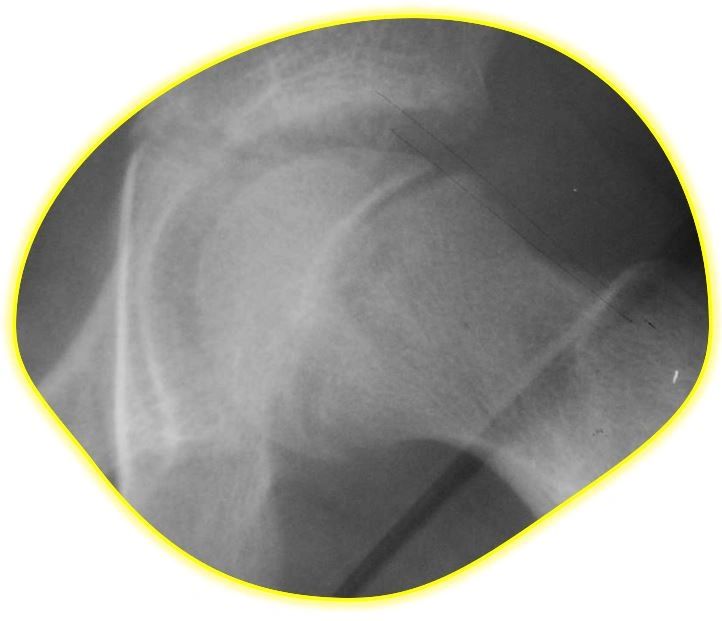
One of the more likely orthopedic findings to be present on boards is slipped capital femoral epiphysis (SCFE), as it is the most commonly seen clinically. SCFE results from the instability of the growth plate of the proximal femur, resulting in an anterior displacement of the capital femoral epiphysis from the femoral head. This is most commonly caused by fat mass disease (i.e., mechanical overload), although it can also be caused by a growth spurt.
Early adolescents will often present with either an abnormal gait or hip pain, with approximately a quarter of children presenting with bilateral SCFE at the time of clinical presentation. This atraumatic, dull pain can be felt in the hip or groin (and sometimes even the knee) and often is worsened with physical activity. It is diagnosed with radiographs, as shown in the featured X-ray image, and requires urgent surgical evaluation.
Here are a few other differentials and possible distractors on test day.
- Blount disease is the bowing of the tibia (varus) and can be seen in children with obesity.
- Legg-Calve-Perthes disease is an idiopathic avascular necrosis of the femoral head and can present similarly to SCFE, as it also impairs internal rotation; however, it usually affects younger patients (ages 5-6 years old) and is not strongly correlated to excess weight or obesity.
- Osgood-Schlatter disease is seen in young, active patients and presents with a pronounced tibial tuberosity. Although this is not necessarily related to children with obesity, you could see this term as a distractor, so be familiar with it.
And that’s it, a short and sweet refresher!
Sample Question
An 11-year-old boy presents to his pediatrician with a complaint of right lower extremity pain. He states the pain has worsened over the past month, describing it as a dull ache. There was no preceding trauma. His mother brought him in after she noticed him walking with a limp. His BMI is in the 120 th percentile for his age. Physical examination reveals limited internal rotation of his right hip and an antalgic gait. Which of the following is most likely the culprit of his presenting condition?
A. Blount disease
B. Slipped capital femoral epiphysis
C. Osgood-Schlatter disease
D. Legg-Calve-Perthes disease
E. Aseptic necrosis
Next Week’s Topic: Motivational interviewing
Upcoming Topics: Immediate RYGB complications: Anastomotic Leak.
For more practice questions, check out the following:
- Obesity Medicine Board Review Questions (2026): Qs 99 and 119.
- Obesity Medicine Practice Tests (2026): Qs 36, 165, 350, and 447.
(Copyright 2026) Obesity Medicine Board Review Questions, LLC: obesitymedicinereview.com
Featured image: SCFE Frog-Leg B&W: Wikimedia commons
Copyediting by Kelly Smith
Now available: A full line of ABOM study resources with 775+ challenging questions in a mobile or book format. Access to both formats is available in a discounted Ultimate Package, which also includes a Pass Guarantee (if you fail the exam in 2026, you get the 2027 edition free), 50 bonus questions released in August, and the newest book, Obesity Medicine: Sample Questions and Study Blogs, which includes all the updated previous study blogs in a paperback format. Check it out here!
